Federal agents in California can wear masks — for now, judge rules
AI-generated summary reviewed by our newsroom.
- Judge finds California mask ban unconstitutional because it exempts state officers.
- Badge identification rule allowed to stand; enforcement delayed until Feb. 19.
- Lawmaker says he has begun rewriting bill to also bar state officers from wearing masks.
California’s ban on federal agents wearing masks is unconstitutional because it exempts state law enforcement officers from the same requirement, a federal judge in Los Angeles ruled Monday. But a parallel requirement that federal officers wear badges and identify themselves was allowed to stand.
U.S. District Judge Christina Snyder issued an injunction barring the state from enforcing the mask prohibition. But she also provided a blueprint for lawmakers to rewrite the statute, dubbed the No Secret Police Act, saying the measure would be legal if state police were also prevented from wearing face coverings.
She declined to issue an injunction against the badge requirement.
“The court finds that federal officers can perform their federal functions without wearing masks,” Snyder wrote in a 30-page ruling. “However, because the No Secret Police Act as presently enacted, does not apply equally to all law enforcement officers in the state, it unlawfully discriminates against federal officers.”
The ruling grew out of a lawsuit filed by the Trump Administration in November against two California statutes set to go into effect this year — the mask-ban and the No Vigilantes Act, which requires federal officers to wear badges and identify themselves. The badge requirement will go into effect as planned, Snyder said, because that law did not exempt state officers.
State Sen. Scott Weiner, D-San Francisco, who authored the No Secret Police Act, said he had already begun rewriting the legislation to ban state officers from wearing masks as well. In a statement posted on his website, he implied that the troublesome provision had been added at the request of the governor’s office.
“We crafted SB 627 in consultation with constitutional law experts,” Weiner said. “Based on communications with the governor’s office, we removed state police from the bill.”
A spokesperson for Gov. Gavin Newsom did not respond to a question from The Bee asking whether the governor would sign a new ban that did not exempt state officials.
But Newsom welcomed Snyder’s ruling in favor of the state’s law requiring federal officers to wear badges, calling it “a clear win for the rule of law.”
“No badge and no name mean no accountability,” Newsom said in a statement posted on his website and on social media. “California will keep standing up for civil rights and our democracy.”
The ruling on the mask ban was welcomed by U.S. Attorney General Pam Bondi, who called it a “key victory” for President Donald Trump’s law and order agenda.
“Following our arguments, a district court in California BLOCKED the enforcement of a law that would have banned federal agents from wearing masks to protect their identities,” Bondi wrote on the social media platform X, formerly Twitter.
“These federal agents are harassed, doxxed, obstructed, and attacked on a regular basis just for doing their jobs,” she wrote. “We have no tolerance for it.”
In filing the lawsuit last fall, the administration said it did not intend to comply with either law.
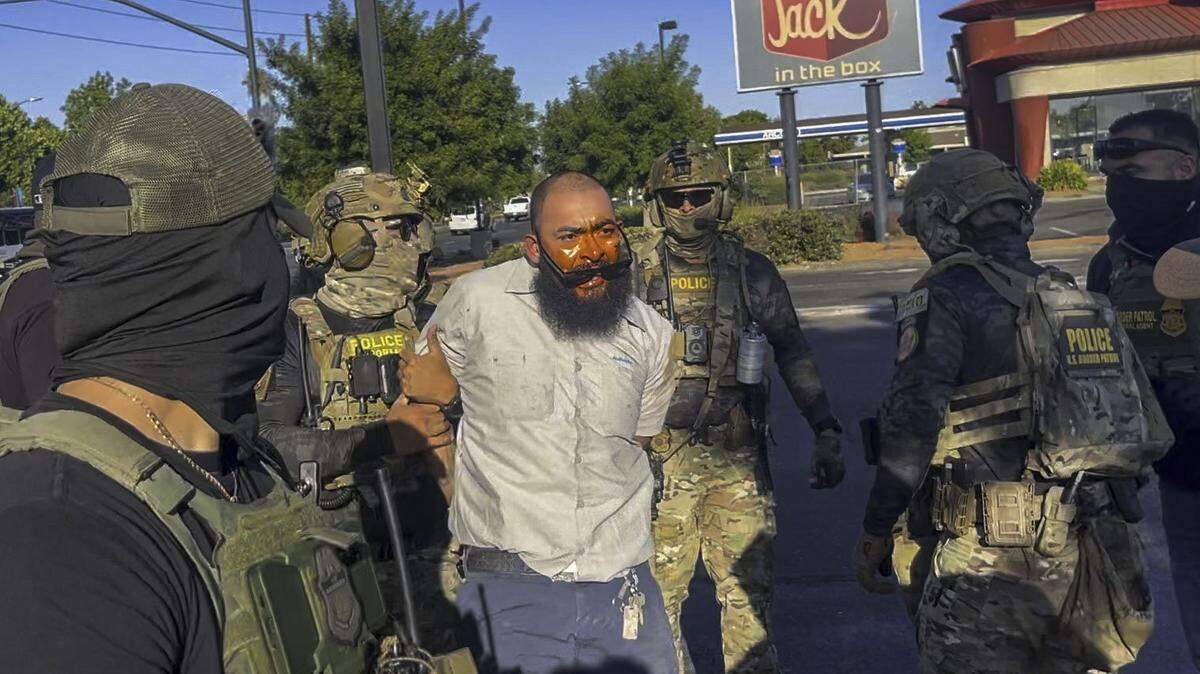
The two laws at issue grew out of concern among Democrats that officers conducting the federal administration’s aggressive immigration sweeps were generally wearing masks and bore little or no identification. Such arrests were at times violent, and people who were detained in the operations said they did not know whether the officials who detained them were really working for law enforcement.
In a court hearing in Fresno last week, a man detained in an immigration sweep in Sacramento said he tried to get away from an immigration officer who had grabbed him, because he did not know who the man was.
In Minnesota this year, two protesters, Renee Good and Alex Pretti, were killed in tense situations that involved masked agents during immigation sweeps in Minneapolis, prompting widespread outrage and leading California lawmakers to introduce a raft of new bills aimed at curbing violence related to such enforcement.
In the Los Angeles case, lawyers for Trump argued that both the mask ban and the badge requirement would expose federal officers to dangerous situations and impede their ability to do their jobs. Immigration enforcement officers had been doxxed and protesters had gone to their homes, exposing their families to added risk, the government said.
But Snyder ruled that these problems were incidental to the work of enforcing the country’s immigration laws.
“Security concerns exist for federal law enforcement officers with and without masks,” she wrote. “If anything, the court finds that the presence of masked and unidentifiable individuals, including law enforcement, is more likely to heighten the sense of insecurity for all.”
Snyder’s order will not go into effect until Feb. 19, giving the Trump administration time to appeal the badge requirement.
This story was originally published February 9, 2026 at 6:29 PM with the headline "Federal agents in California can wear masks — for now, judge rules."