CA bill could speed up housing near transit. One Sacramento-area city doesn’t like it
AI-generated summary reviewed by our newsroom.
- Senate Bill 79 would require cities to largely approve housing developments near transit that meet criteria.
- The bill faces key votes in the Legislature this week.
- Sacramento leaders expressed support for the measure.
Desmond Parrington, Folsom’s planning manager, is tired of new housing-related mandates coming from California’s Legislature.
For years, he and other city planning officials worked to update the community’s housing blueprint for the future. Parrington said they intentionally identified areas where the city, northeast of Sacramento, could add more places to live to keep up with state mandates. The City Council unanimously approved the changes last year.
But he worries that a controversial measure pending in the Legislature could undermine that work.
Senate Bill 79 would require many local communities to approve more housing developments near train and bus stations. Cities could come up with alternative ideas, but they still must follow specific rules and be approved by the state.
Folsom’s long-term plan already allows for denser projects near light rail stations. But Parrington said city officials may have to modify its goals again to meet new standards under the proposal.
“With the state moving the goal posts every year it’s impossible to keep up because we’re so busy updating plans, updating our ordinances,” he said. “We’d rather spend the time actually figuring out how to get projects built.”

Lawmakers have until Friday, the end of this year’s legislative session, to pass the bill and move it to Gov. Gavin Newsom’s desk. It was introduced by state Sen. Scott Wiener, D-San Francisco, who pitches the measure as a way to support struggling public transit agencies and to help stem the number of people fleeing the state over explosive housing costs.
Months of sharp debate over the bill highlight a point of tension in California’s housing politics: How much say should city leaders have over development projects in their communities?
Wiener believes it should be less than it is now, to put a dent in the state’s severe shortage of affordable places to live. He said he appreciates work many cities are doing, but wants to see more action.
“Our land use patterns in California are not sustainable,” he said. “We have job centers and transit-rich areas where we have allowed cities to zone for very little housing and that’s exactly where we should be putting the housing.”
‘A hard fought bill’
The measure could limit cities in multiple ways.
It would largely force them to allow projects on properties within one-half mile of transit stops, even on land that is zoned for commercial or mixed use, or potentially face a fine for violating the state’s Housing Accountability Act.
Based on how close a development is to a station, communities would also generally be prevented from imposing some height and density limits. For example, within one-quarter mile of certain Bay Area Rapid Transit stops, or those of other rail systems, local governments could not force projects to be less than 75 feet high.

The bill only applies to communities in more urban counties and those with at least 35,000 people. Wiener argues the measure’s option for cities to submit alternative plans gives local governments flexibility to meet the new rules.
Still, many communities have come out against the bill. Roseville, another Sacramento-area city, is one of them.
Rob Baquera, a Roseville government relations manager, said the city opposes the loss of local control for planning and zoning. But recent changes to the bill could mean that the city may not be affected at all.
But the bill also has received support from city leaders across the state, including those in Emeryville, San Diego and Santa Monica.
Sacramento has not taken a formal position, but Mayor Kevin McCarty supports it, his spokesperson said. So does Councilmember Caity Maple.
“Building housing is more important than this feeling of local control, for me,” she said.
Maple acknowledged that adding new requirements could force cities to have to update their long-term plans. “But I see this bill more as getting out of our own way,” she said.
Wiener has also had to navigate claims that the bill would not do enough to promote affordable housing, could displace long-time residents who live near stations and that it did not include labor standards.
Since introducing the measure in January, he has revised it more than a dozen times. The bill passed by only one vote in the Senate in June with support from both Republicans and Democrats.
Assemblymember Josh Hoover, R-Folsom, voted in favor of an earlier version of the bill during a July committee hearing. He and his spokesperson did not respond to interview requests about where he stands on it now.
The measure needs to pass the Assembly and be approved again by the Senate before going to Newsom.
“We’ve been building momentum for SB 79 for months,” Wiener said. “It is a hard-fought bill — it’s not an easy one — but we’ve been getting more and more support.”
On Friday, his office announced that the influential State Building and Construction Trades Council of California would no longer oppose the bill in response to several amendments. The measure now generally requires projects above 85 feet or on land owned by transit agencies to use labor standards or agreements.
The union is a major donor in state politics. During the first half of the year, its political action committees contributed more than $350,000 combined to the California Democratic Party and to campaign committees for Democratic legislators, according to state records.
Chris Hannan, the union’s president, said in a statement that the changes to the measure “will create good jobs, provide training for the next generation of California’s skilled construction workforce, and ensure that this desperately needed housing is built with quality and that workers are treated with dignity.”
‘Context sensitive’ development
The Folsom city plan that Parrington and other officials worked on for years lists a series of guiding principles, the first of which is to “preserve and enhance Folsom’s small town charm.”
The community, which started as a Gold Rush-era town, has seen major growth in recent decades, adding more than 30,000 people since 2000, according to U.S. Census Bureau estimates.
Parrington said he realizes the area has housing needs, but addressing them is not simple. There are costly sewage and drainage improvements that need to take place to support larger developments and he also fears the potential backlash from residents if tall apartment complexes pop up in places where they’re not wanted.
The updated plan identified areas to add more than 6,000 new units for people to live by 2035, according to the city.
“We were very specific about the properties where we felt there was the potential for development,” Parrington said.
Recent amendments to SB 79 give communities more flexibility to meet its requirements in areas with historic sites. But Parrington still has concerns that it could affect the city’s historic district, which is next to a light rail station.
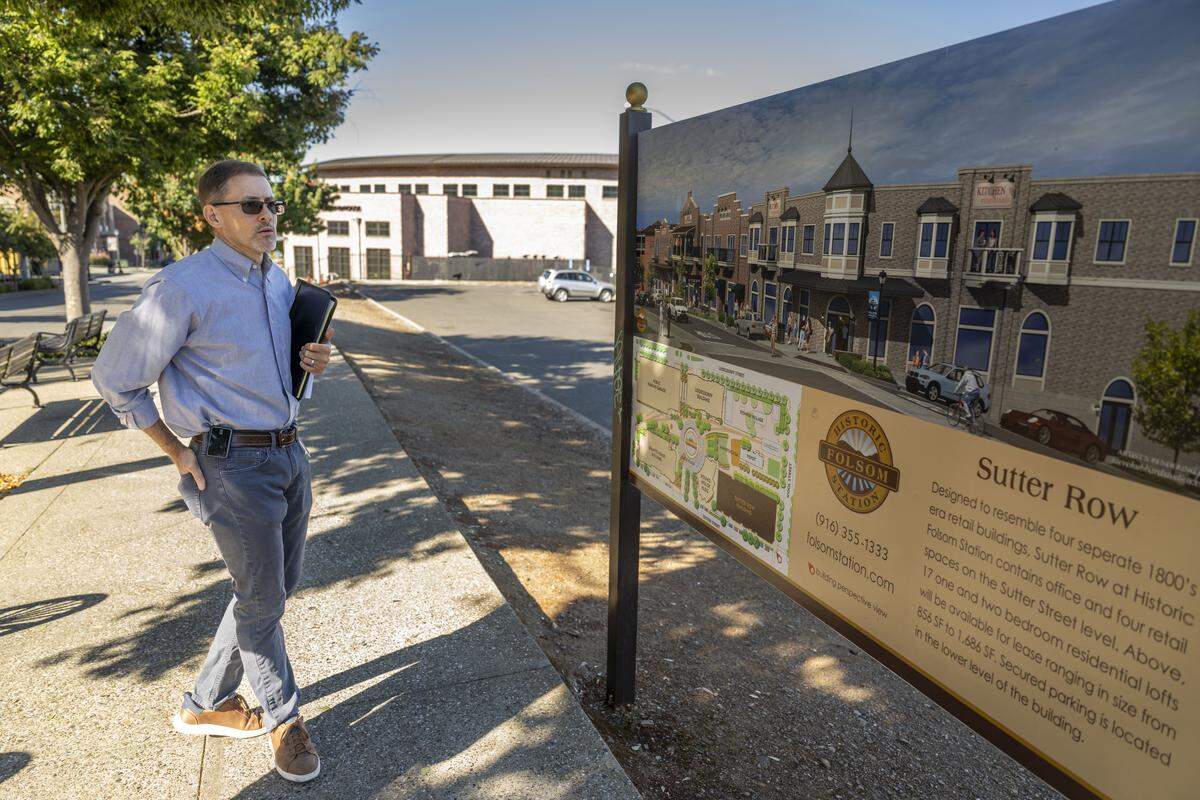
The area is filled with mostly single- and two-story buildings, some of which date back to the 1800s. There are also signs highlighting plans for future projects.
One was inspired by an 1800s-era Folsom hotel and calls for 30 lofts. Another, designed to resemble retail buildings from the 1800s, would add 17 rentals.
Parrington sees those ideas as striking a balance: adding more housing to the historic area but doing so in a “context sensitive way.” He said officials also tried to do that throughout the city with its long-term goals.
“We’ve been working on this for quite some time,” he said. “It’s not something where we’re saying, ‘No, we don’t want any more housing development in Folsom.’”
This story was originally published September 9, 2025 at 6:00 AM with the headline "CA bill could speed up housing near transit. One Sacramento-area city doesn’t like it."