
Why do so many people outside California hate the Golden State?
President Donald Trump mentioned California’s governor and Los Angeles’ mayor during a speech Tuesday and the crowd booed. What made this unusual is that the crowd was gathered at Fort Bragg, North Carolina, 2,556 miles away.
The incident was a fresh example of a political strategy Republicans have used for years, one that Trump’s thrown into a higher gear: Bash California.
Chances were that few in the North Carolina audience Tuesday audience could pick Gov. Gavin Newsom or Los Angeles Mayor Karen Bass out of a crowd. But they were symbols of so much Republicans say they’re against, and so far, that’s proven to be good conservative politics.
In the minds of many outside the state, “California is an idea,” said Ross Baker, professor of political science at Rutgers University in New Jersey. “It has great symbolic value.”
The state has been an easy target for Republicans for decades but perhaps not without cause, said Kate deGruyter, senior communications director for Third Way, a center-left think tank in Washington, D.C.
“California, for probably a lot of the country, is the epitome of coastal elites and epicenter of liberal ideology,” she said.
GOP governors of more conservative states such as Florida, Idaho and Utah often point to California’s problems – housing costs, homelessness, wildfires – as a warning against policies like government regulation and high taxes.
Though Democrats have held a trifecta of control over the executive branch and both chambers in the state Legislature, there’s often a sense the party hasn’t delivered on promises such as affordable housing or high-speed rail. “It’s sort of a picture of how Democratic governance isn’t delivering what we profess voters should be able to expect,” deGruyter said.
People know California
Opinions about California may be stronger than about most states because so much that happens in the state is magnified because it’s the entertainment capital of the world and has one of its largest economies. The state has long been a trend-setter culturally, economically and politically.
People feel they know California.
“America loves California. We hate California politics because it’s extreme left, and extreme left is not where the country is,” said Mark Campbell, a Republican strategist whose campaign resume includes former President George W. Bush and Virginia Gov. Glenn Youngkin.
The vast majority of the state’s tourism revenue last year — more than $131 billion — came from U.S.-based visitors, according to a Visit California report.
“People don’t go to western Nebraska on vacation. They come to see Hollywood,” said Rep. Brad Sherman, D-Sherman Oaks.
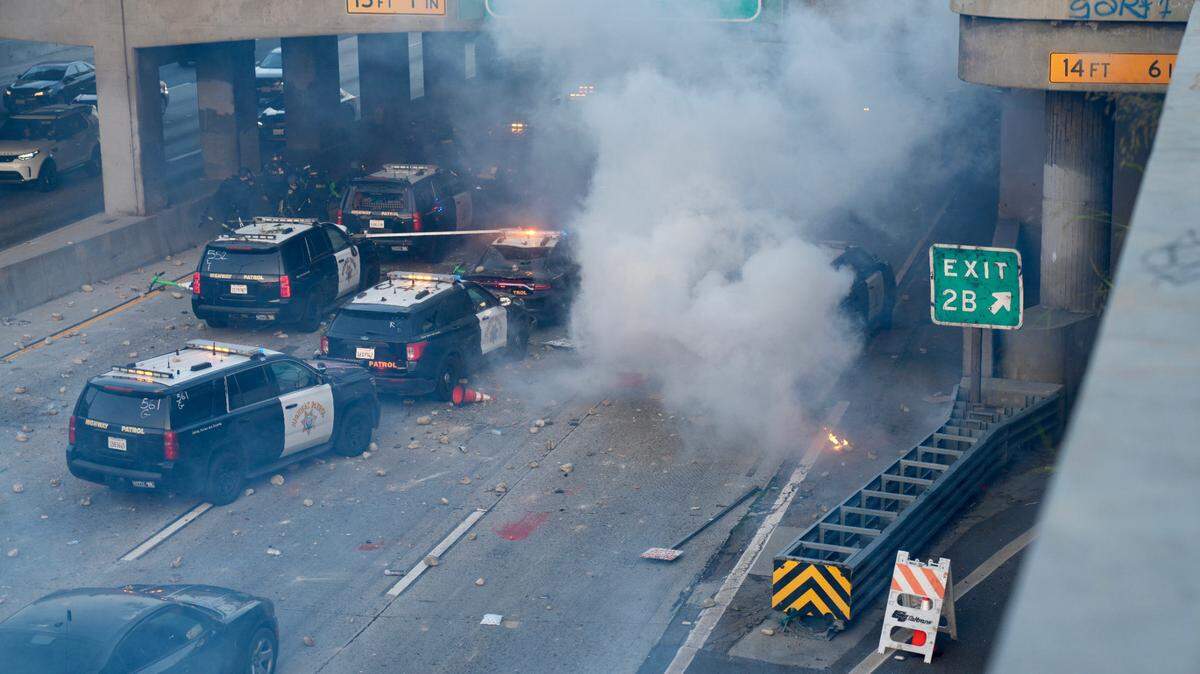
But they don’t necessarily know the geography of Los Angeles. They don’t know that the anti-deportation protests are confined to a small area but keep hearing Trump saying that without the help of the National Guard the city would burn down.
And because this happens in the Golden State, “If there’s civil unrest it gets magnified 10 times because it is California,” said Lee Miringoff, director of the Marist Institute for Public Opinion in New York.
Republicans and California
Republicans relentlessly painted the city this week as an out of control war zone governed by hapless liberals.
“Over the weekend, chaos erupted in the streets of Los Angeles as illegal immigrants led violent riots, torching property, blocked roads, and endangered Californians,” said Christian Martinez, spokesman for the National Republican Congressional Committee, one of the GOP’s political arms..
Tuesday at Fort Bragg in North Carolina – a place where politics usually is put aside –Trump repeated his claims about the protests.
“These are animals, but they proudly carry the flags of other countries. They don’t carry the American flag. They only burn it. Did you see a lot of the flags being burned?” Trump asked the audience of military personnel and their families.
Thursday, Homeland Secretary Kristi Noem reiterated those points at a Los Angeles press conference, where U.S. Sen. Alex Padilla, D-California, was forcibly ousted and handcuffed after trying to quietly ask her a question.
Afterward, Tricia McLaughlin, a Homeland Security spokeswoman, tweeted “There’s no excuse for busting into a press conference and interrupting it. Had Senator Padilla asked for a meeting, @Sec_Noem would have happily obliged, which she graciously did for 15 minutes after the press conference.” They did eventually meet briefly.
To Republicans, removing Padilla from the Noem event was proper. “Padilla entered a high-security federal facility under false pretenses and crashed an invite-only press conference as law enforcement are working around the clock to calm violent riots. Shameful,” McLaughlin said.
A long history
The episodes followed days and years of similar California-bashing. At the 1984 Republican convention, the GOP criticized “San Francisco Democrats,” or liberals. Conservative commentator Bill O’Reilly popularized the “San Francisco values” term in the 1990s, as Republicans used it to paint Democrats as anything-goes radicals.
By 2006, the San Francisco Chronicle’s Joe Garofoli wrote, “Over the space of a few days, the phrase “San Francisco values” has passed from the lips of conservative FOX News commentator Bill O’Reilly and former House Speaker Newt Gingrich onto the editorial pages of the Augusta (Ga.) Chronicle, where the paper endorsed a Republican congressional candidate because a Democratic House would mean “Pelosi will be speaker and her far-left San Francisco values – gay marriage, cutting and running from Iraq, coddling terrorists, raising taxes, amnesty for illegals – will become the House agenda.’
Nancy Pelosi was about to become Speaker of the House in 2006. She’s still a congresswoman from San Francisco.
The beat goes on.
Rep. Kevin Kiley, R-Roseville, earlier this month spent an hour on the House floor listing “the 10 radical failed policies of Gov. Gavin Newsom.”
On the Senate floor last week, Majority Whip John Barrasso, R-Wyoming, said “the official stance of today’s radical Democrat Party is to side with illegal immigrants and rioters, not law-abiding Americans,”
Thursday, Trump signed into law bills that would overturn California’s efforts to ban or restrict gasoline-powered vehicles.
He blamed the Biden administration for encouraging those rules. “Under the previous administration, the federal government gave left-wing radicals in California dictatorial powers to control the future of the entire car industry all over the country, all over the world, actually,” Trump said.
California personified
Three presidents, all Republicans, had California ties: Herbert Hoover, Richard Nixon and Ronald Reagan.
But last year’s election marked the first time the Democratic presidential nominee, Kamala Harris, hailed from the Golden State.
Harris also ran in the 2020 Democratic primary. During that campaign, “Kamala Harris was a perfect test case for California on the ballot,” said Matt Shupe, a strategist and spokesman for the California Republican Party.
She dropped out in late 2019, before any states held primaries.
If he runs for president in 2028 as many anticipate, Newsom will carry baggage as a leader of the state many Americans see as too far left.
“To people in other states, Gavin Newsom represents everything wrong with California,” Shupe said.
While Newsom’s recent punches against the Trump administration will endear him to Democratic voters who oppose the president, the “San Francisco liberal” label will likely stick with him.
“In this hyper-polarized environment that’s our national politics, California is seen as the liberal bastion,” said Michael Bitzer, professor of politics and history at Catawba College in Salisbury, North Carolina.
For all the California-bashing, the state remains one of the world’s largest economies, still the place where aspiring actors and filmmakers go to pursue their dreams, whose rich agricultural fields are crucial to feeding America.
“This state has been political fodder since I’ve been involved in politics,” said Rep. Mike Thompson, D-St. Helena. “Republicans need something to criticize because they don’t have anything good to say about themselves.”
Veteran politicians like Thompson and Sherman have heard all this before.
Remember, said Sherman, “we may turn out to be a tougher target than they realize.”
This story was originally published June 15, 2025 at 5:00 AM with the headline "Why do so many people outside California hate the Golden State?."
.jpg)