Gavin Newsom wants California exempted from foreign tariffs. Can he do that?
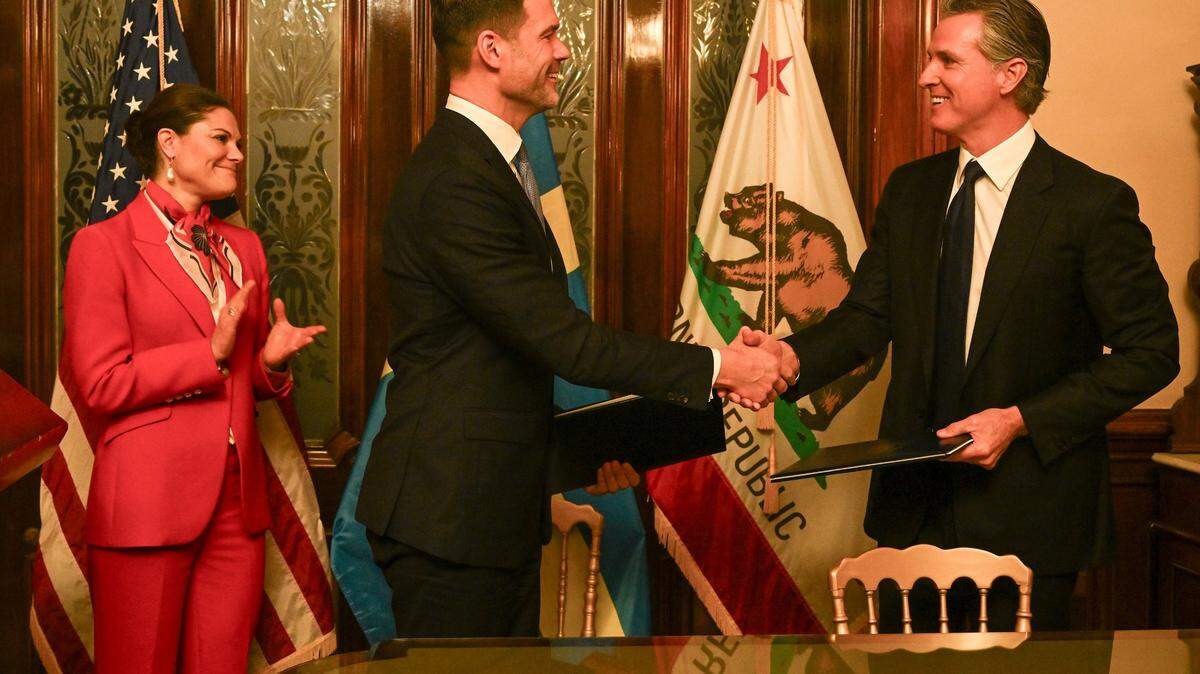
Gov. Gavin Newsom can’t negotiate tariff deals with other countries. But he can negotiate with private companies in other countries and give them incentives to do business with California.
“He cannot impose or not impose duties on their imports, but he can say to companies, ‘please give us a break on exports,’’’ said Alex Jacquez, chief of policy and advocacy at Groundwork Collaborative.
Newsom Friday asked world leaders to spare California from paying the tariffs imposed Wednesday by President Donald Trump. The “Liberation Day” tariffs have tanked markets around the world and threaten to dramatically inflate prices or delay sales of most everything from cars to the forthcoming Nintendo Switch 2.
The governor spoke out on Thursday and Friday against the tariffs, which he called “the largest tax hike of our lifetime.” On his podcast, one-time Trump spokesperson and financier Anthony Scaramucci said the tariffs would spark a recession identical to the one that triggered the Great Depression.
“What he’s doing is taking us back to the 1930s, with the Smoot-Hawley Act,” said Scaramucci, referring to the protectionist trade measures levied by President Herbert Hoover that economists cite as a contributing factor to the most economically devastating downturn of the 20th century.
California, which if it were a country would be the world’s fifth largest economy, depends heavily on trade. An estimated 2.3 million of the state’s 18 million non-farm jobs involve trade.
But when it comes to taxes on trade, it’s mostly a federal matter.
Article I, Section 8 of the U.S. Constitution explicitly says, “The Congress shall have Power to lay and collect Taxes, Duties, Imposts and Excises, … but all Duties, Imposts and Excises shall be uniform throughout the United States.”
Congress has given the president the ability to unilaterally impose tariffs, as Trump did this week. But it didn’t give that power to any state official.
Article 1, Section 10 specifically bars states from “entering into treaties, alliances, or confederations,” with foreign nations.
All that means is while California could send a delegation to a foreign country to promote the state’s businesses and industries, “the actual trade rules, tariffs, and binding agreements are still handled in D.C.,” said Sung Won Sohn, president of SS Economics in Los Angeles.
“If California ever tried to negotiate a binding trade agreement, it would likely be struck down by the courts or blocked by the federal government,” he said.
Newsom’s limited power
Newsom does have one path to exempting his state. He could request that “customs duty on a specific category of goods does not have to be paid,” said Gokce Soydemir, Foster Farms endowed professor of business economics at California State University, Stanislaus.
But such requests would be handled by the federal Commerce Department, which is headed by Trump ally Howard Lutnick.
Another thought: In Trump’s first term, retaliation for tariffs generally was aimed at more conservative states, as countries tried to make Trump-friendly areas pay a political price.
“Under this old logic, Newsom could argue that tariffs on California won’t create any new political pressure that would lead to a Trump reversal or modification of the April 2 tariff plan,” said Deborah Swenson, professor of economics at the University of California, Davis.Swenson.
But, she said, “if foreign countries are looking for leverage points, I could see them targeting the tech sector given Trump’s tight connections in this area. This would obviously create a heavy hit to California.”
What could work in Newsom’s favor is that the state has a long history of making deals with foreign interests to lure them to California.
“States have economic ambassadors that go overseas,” said Jacquez, a former special assistant at President Joe Biden’s National Economic Council. “They can say we can subsidize, we can give you tax breaks.”
That’s unlikely to offset the impact of the sweeping tariffs, though. Newsom can’t give a tax break to every company doing business in California, particularly with the state deficit climbing. A spokesperson for Dee Dee Myers, Newsom’s business adviser, said the governor was not targeting any particular industry or company, but trying to ensure California would still honor its trade agreements with other countries despite the White House’s aggressive stance.
And, said Jacquez, the Trump administration will be watching closely to make sure he’s not doing anything illegal.
“He has to be circumspect how he approaches that with exact words. He can’t sign treaties or do anything official,” Jacquez said.
Tariffs and California’s economy
Newsom faces another serious question: How much of a problem will tariffs be for the state’s economy, which is heavily reliant upon high-income earners, many of whom draw their wealth from stocks.
The UCLA Anderson Forecast issued a recession watch last month, citing tariffs as one factor in a possible downturn. But there are others, notably Trump’s crackdown on undocumented immigrants, which the Forecast saw as having the potential for reducing the labor pool in the state.
Jerome Powell, the chair of the Federal Reserve, said Friday that the tariffs’ likely impact on the economy and inflation were “significantly larger than expected.”
At the moment, though, most experts are cautious. While growth is likely to slow, they say, no sharp recession is imminent.
“I do think that the initial media and political responses to the tariffs announced this week are overreactions. We’re likely to see a good deal of negotiations and shifts in the next few weeks and months,” said Michael Bernick, former state Employment Development Director and now an employment attorney at Duane Morris LLP.
This story was originally published April 4, 2025 at 12:06 PM with the headline "Gavin Newsom wants California exempted from foreign tariffs. Can he do that?."
.jpg)