Reparations bills die on final day of California’s legislative session despite urgent protests
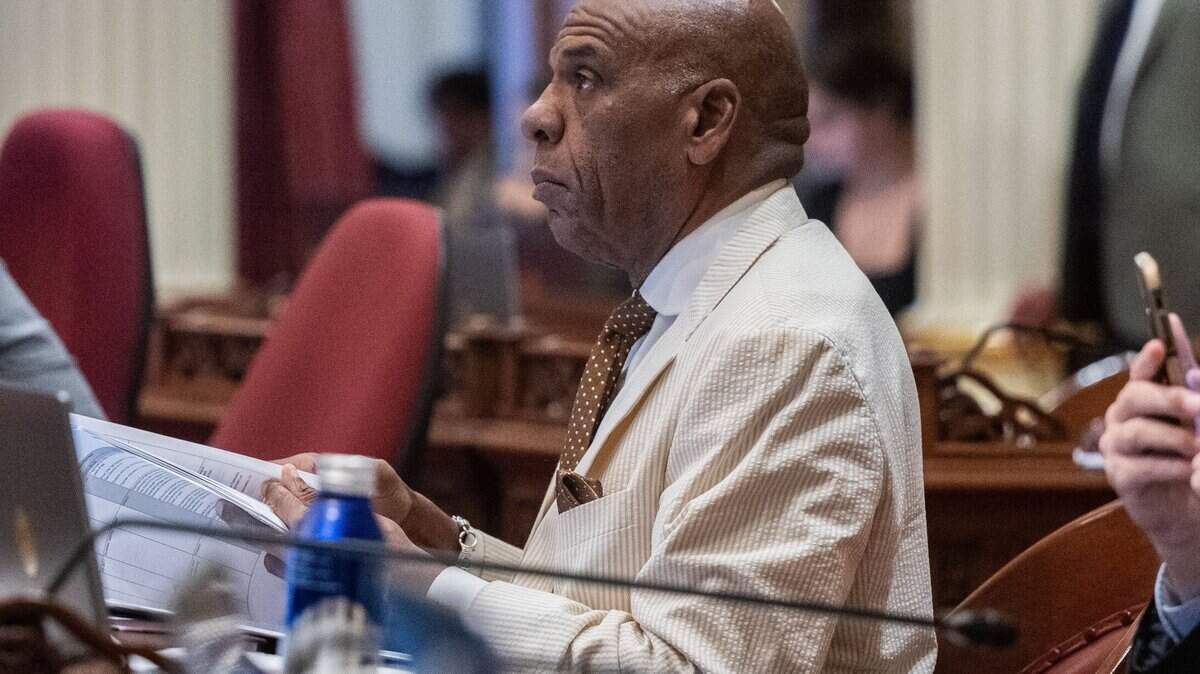
After hours of fierce lobbying, protests and uncertainty Saturday, California lawmakers killed two bills that their supporters had hoped would help repair harms committed against Black residents and their descendants.
That ended several days of frustration for advocates who were eager to see the Legislature pass Senate Bills 1403 and 1331, which would have created a new state agency to oversee reparations and a fund to help support those policies.
“We owe it to our ancestors,” said Sen. Steven Bradford, a Gardena Democrat who authored the bills. “And I think we disappointed them in a way.”
The uncertainty over the fate of the bills led Reggie Romain to get into his car before the sun rose in Southern California Saturday morning and travel north with a group of demonstrators. He had a forceful request: “We got to get these bills,” he said in the afternoon, under the dome of the state Capitol.
The measures came out of two years of study by a first-in-the-nation state task force, which produced lengthy reports and a series of recommendations. Bradford was a member of the group.
But, as the measures were close to passing in the Legislature, they stalled in the Assembly for days. That came after Gov. Gavin Newsom raised concerns about the bill creating the new agency and his administration proposed changes that would have scrapped it, The Sacramento Bee previously reported. Those suggestions were rejected by Bradford.
Romain wasn’t going to watch the last day of the state’s 2023-24 legislative session all the way from Riverside County, where he lives. He is a barber and canceled his appointments planned for the day, so he could make his feelings known.
“My ancestors talked to me,” Romain said. “I got to be here. I got to make this journey.”
Romain was one of the roughly two dozen protesters who came to the Capitol. Their shouts for the bills to move forward and chants for reparations “now” echoed in an area under the building’s dome, which was filled with lobbyists. They held up signs with the same message and yelled at lawmakers who were walking to and from the Assembly floor. Their cries could be heard at times inside the chamber.
At one point, Assemblyman Isaac Bryan, a Los Angeles Democrat, went to speak with them.
“I don’t understand why y’all can’t just bring the bills up,” said Chris Lodgson, a lead organizer with the Coalition for a Just and Equitable California, a major supportive of state reparations efforts.
“The same reason I couldn’t sign them too,” Bryan said. “The building doesn’t move, you know what I’m saying? It’s hard to move s---.”
Bradford said he had the votes for them to pass, but assembly members in the California Legislative Black Caucus did not bring them forward.
The group’s chair, Assemblywoman Lori Wilson, a Suisun City Democrat, disputed that Bradford actually had enough support. She said lawmakers in the next legislative session would continue to push for reparations bills.
“We’re committed to that,” Wilson said.
The pending measures were not on a priority list of reparations bills unveiled by the Black caucus in January. Many of those 14 proposals passed, including one that would issue a formal apology for the state’s role in permitting slavery and discrimination. It is waiting for final approval from Newsom.
Bradford has reached his term limit and can no longer serve in the Legislature. And those who came to the Capitol on Saturday didn’t want to wait for future lawmakers to pass the bills.
“It would be unconscionable, I think, for any assembly member to fail to put these bills to the floor let alone a member of the esteemed institution, like the California Legislative Black Caucus,” said Kamilah Moore, an attorney who served as the chair of the task force. “We worked really hard over the course of two years and these last two bills in particular are sourced from some of the more stronger recommendations from the task force.”
Moore left the Los Angeles area early Saturday to get to Sacramento and was in the Capitol after the bills died at midnight.
Bradford had wanted to bring up the measures on Wednesday. But The Bee previously reported that the Newsom administration presented the senator with changes to Senate Bill 1403, which would create a California American Freedmen Affairs Agency. The suggested amendments would not have created the agency but instead set aside $6 million for the California State University system to lead a study of reparations and recommend a process for determining someone’s eligibility for them.
Wilson disputed that the Newsom administration had proposed amendments and that the suggested changes would have turned it into a “study bill,” while speaking with reporters.
There was not enough funding to create the new agency and keep it going, she said, so the goal was to use “existing infrastructure to be able to set up this type of agency, or this type of work.” Wilson said the Black caucus had proposed the changes.
When asked about Wilson’s comments, Bradford told reporters that his staff received proposed amendments from the governor’s office on Monday. He said the concern seemed to be over the cost of the bill, but Bradford said there was enough money to get the agency going.
The state’s current budget included $12 million to help implement reparations-related policies. The California Government Operations Agency estimated the new division would cost $3 million to $5 million annually to run.
“We were moving these bills with the understanding that we had the votes to take it up on the Assembly floor,” he said.
Despite Wilson declaring the bills dead, protesters furiously lobbied lawmakers to see if they would go around the Black caucus and bring up the measures.
One of the bills almost came up around 8 p.m. Saturday at the suggestion of an unlikely supporter: Assemblyman Bill Essayli, a Corona Republican and outspoken critic of Democrats.
The suggestion sent lawmakers into a frenzy, as they paced the floor, huddled with each other and several went up to speak with Essayli. One lawmaker said “Oh my God” near the back of the floor while waiting for the Assembly’s next steps. Eventually, Essayli’s request died after no other lawmaker supported it.
Assembly Speaker Robert Rivas, a Salinas Democrat, told reporters in a press conference after the session ended that he had met with members of the Black caucus about the bills. He referred questions to the group about why the measure did not come up for a vote.
In a statement, it said it had “chosen to concentrate our collective energy on the legislative priorities that the entire caucus had voted on and those that positively impact Black Californians.”
Darlene Crumedy had traveled from Fairfield to the Capitol for several days hoping to see the two bills pass. She had attended task force meetings around the state and went to legislative hearings where the bills were heard.
She said members of the Black caucus were acting “cowardly” when they decided not to bring the measures forward. And she said it would have political consequences.
Crumedy, who lives in Wilson’s district, said she would not vote for the lawmaker in November.
This story was originally published August 31, 2024 at 4:45 PM with the headline "Reparations bills die on final day of California’s legislative session despite urgent protests."