Are California ballot measures a ‘parallel legislature’ for wealthy interests? Labor thinks so
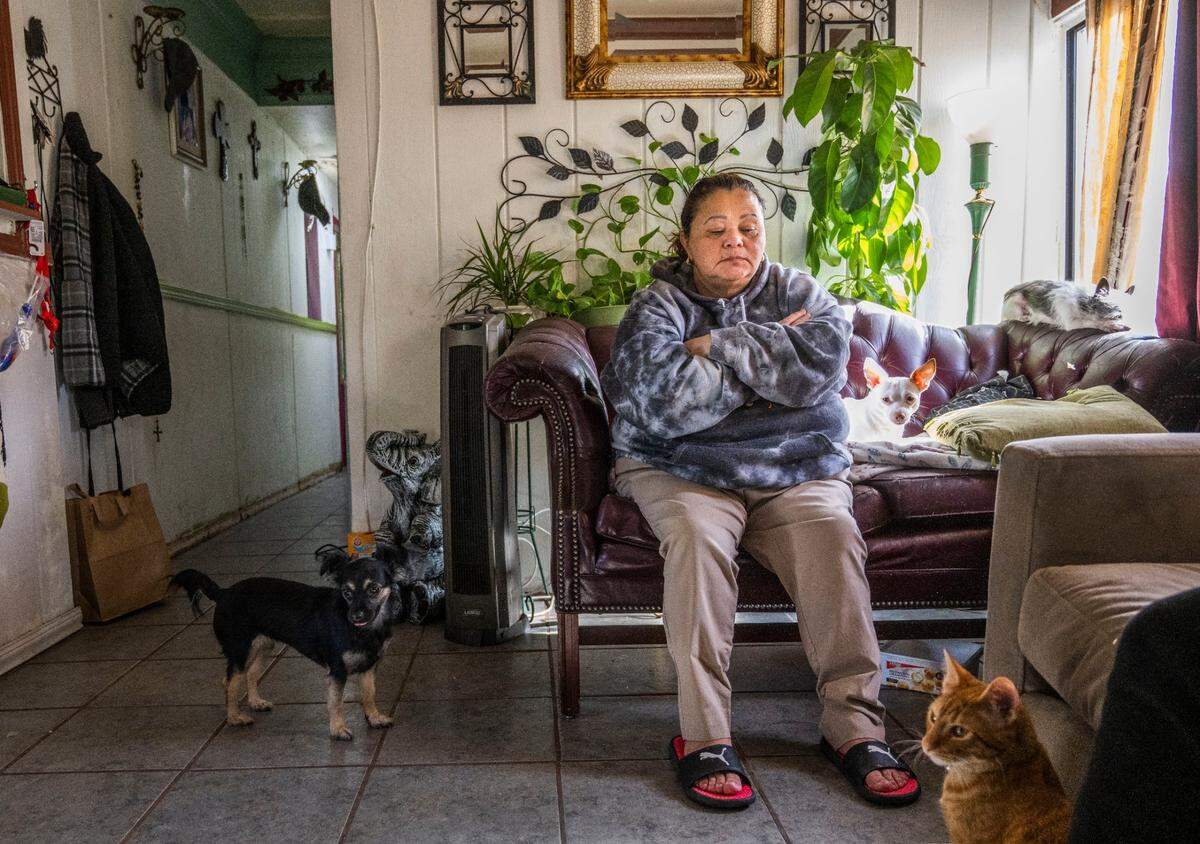
On a good week, Sandra Jauregui might have a few moments to catch her favorite telenovela “La Reina del Sur’‘ (“The Queen of the South”) in the tiny North Sacramento trailer she shares with her three grandchildren, four dogs and one cat.
Those moments are rare for the 50-year-old Guatemalan native. Her seven-day work week is divided between two minimum-wage jobs at Jack in the Box and a laundromat. On weekends, she sells pupusas from her home. And three months ago she became the primary caretaker for her daughter’s children, who immigrated from Guatemala.
“I don’t have free time,” Jauregui said in Spanish, with a laugh.
That’s why Jauregui and other workers fought hard for the FAST Recovery Act – a law that would create a government-backed council to set pay and workplace safety standards across California’s fast-food industry. Workers say the law would give them a much-needed voice in regulating a sector of the state economy that employs more than a half-million people.
After its narrow passage by the Legislature, Gov. Gavin Newsom chose Labor Day to sign the bill into law. But the fight is far from over.
A day later, opponents filed a referendum to halt formation of the council and put the FAST Act on the 2024 ballot, where voters could affirm or repeal it. Save Local Restaurants, a coalition of franchisees, corporations and business trade groups, argues that voters should strike down the law to avoid higher food prices and new regulatory burdens for franchise owners.
“The only thing certain is that the law will create a redundant, unelected council of political appointees with extraordinary power to establish mandates for tens of thousands of counter-service restaurants and dramatically increase the cost of doing business in California,” said the coalition in a statement.
The industry’s referendum challenge marks the latest skirmish in what labor leaders describe as a forever war to preserve gains won through the Legislature.
Unions, buoyed by Democratic supermajorities in the California Assembly and Senate for most of the last decade, have secured a series of significant victories. In reaction, they say, corporations and wealthy conservative groups have leveraged the state’s direct democracy process as a “parallel legislature” to walk back some of those gains.
In 2020, for example, app-based gig companies poured more than $200 million into a ballot initiative that partially repealed a state law that would have required them to provide more employment benefits to workers.
That same year, the state’s billion-dollar bail bond industry followed the same playbook, spending $7.5 million on a referendum that voided reforms to California’s cash bail system. The target was a law that abolished the practice of forcing detained suspects to pay cash for pretrial release and instead established risk assessments as a more equitable solution.
Tobacco companies and oil conglomerates have also used the referendum process to delay the implementation of laws and squeeze out more profits.
“It’s not a level playing field,” said John Matsusaka, executive director of the Initiative and Referendum Institute at the University of Southern California who has studied direct democracy for over 30 years. “It’s super hard if the other side has tons more money than you.”
Save Local Restaurants raised more than $13.7 million between last January and September. If it gathers enough verified signatures by Dec. 4, workers like Jauregui will have to keep fighting for the council through the 2024 election.
“It’s unfortunate that they have to go this extra mile, because they sacrificed a lot,” said Assemblyman Chris Holden, D-Pasadena, who authored the fast-food council bill. “They were going to every member’s office just like the opposition. They were making their case.”
A conservative check on labor
While national support for organized labor has fluctuated over the last century, unions continuously wield outsize clout in California politics thanks to Democratic dominance.
Since 2011, labor-backed lawmakers led by then-Assemblywoman Lorena Gonzalez passed measures raising the minimum wage, improving workplace retirement plans and imposing wage theft protections. They also expanded sick leave and allowed farm workers to earn overtime. Gonzalez has since become the head of the California Labor Federation.
.JPG "SAC_HA08262022UFWMarch5826 (1).JPG")
Pro-labor candidates further cemented support for union-friendly policies in California by picking up seats in the 2022 midterm elections.
Ken Jacobs, chair of the UC Berkeley Labor Center, highlighted the victories of Assemblywomen Liz Ortega and Pilar Schiavo as examples. Both Ortega and Schiavo, who have a long history with advocating for labor, won legislative seats for the first time earlier this month.
Jacobs expects the trend of union-backed candidates to continue given the recent upsurge in support for organized labor. An August poll found that 71% of Americans approve of labor unions — the highest percentage since 1965.
“Clearly, in California, union’s political power has grown in the state,” he said
Where big business and wealthy individuals can dominate, though, is in ballot measure campaigns. They can invest hundreds of millions of dollars in ads, giving them an advantage unions can’t match.
“Generally, whoever spends the most money tends to win initiatives,” Jacobs said.
Campaigns with deep pockets can essentially buy their way onto the ballot by paying petition circulators, or “mercenaries’‘ as critics call them, to gather voters’ signatures. Many come from out of state and earn as much as $8 to $10 per signature.
“The conventional wisdom is that if you’re willing to write a check for $2 to $3 million, you can get a proposal on the ballot,” Matsusaka said. “People will just sign almost anything when there’s a clipboard there and they just want to get out of the supermarket and get home.”
The result is that California’s ballot measure campaigns are now the second-most expensive elections in the world after the U.S. presidential contests, according to David McCuan, a political science professor at Sonoma State. The surge in spending can also be attributed to a 2011 law that required ballot questions to go before voters in November, rather than in primary or special elections.
Lawmakers supporting the change argued that low-turnout elections didn’t accurately represent the will of the general electorate, and that moving the measures to November would make the process more democratic.
But concentrating all initiatives and referendums in November raised the stakes. Campaigns grew longer and poured even more money into the already-rich “initiative industrial complex” made up of political consultants, advertising strategists, signature-gathering firms and their paid foot-soldiers.
“You see a lot more nuclear war,” McCuan said.
Six of the eight most expensive ballot measure races in the last two decades came after 2011, according to Ballotpedia’s analysis of CalAccess data. Only 66 referendum petitions were filed in this century preceding the 2011 law. Since it passed 11 years ago, 28 petitions have been filed.
Gig drivers get ‘déjà vu’
Cardell Calloway and Hector Castellanos know all about moneyed ballot initiatives. The two rideshare and delivery drivers faced a similar challenge when companies like Uber, Lyft and DoorDash bankrolled an initiative to repeal hard-won labor legislation that would’ve guaranteed gig workers benefits like minimum wage, paid time off, worker’s compensation and unemployment eligibility.
“It hurts my heart,” Calloway said of the effort to repeal the fast-food council. “It makes me feel like these companies are an enemy of the people.”
Calloway and Castellanos fought hard for Assembly Bill 5, California’s landmark labor law that required more businesses to hire workers as full employees. The two men were shocked that their independent contractor status prevented them from receiving worker’s compensation or unemployment payments after they both sustained severe injuries from on-the-job car accidents.
.JPG "LEDE_082819_JP_Uber-LyftRally063 (1).JPG")
“I don’t want to see any drivers suffer what I’m suffering,” said Castellanos, who has driven full-time for Uber and Lyft for about eight years. When he underwent shoulder surgery after an accident a few years ago, his daughter had to drop out of college and work full time to support the family while he recovered.
Calloway said the support from Democratic legislators in Sacramento was key to getting the law passed.
“They always had our back,” he said. “They helped us get AB 5 passed.”
The law faced criticism from some workers, like truckers, after it passed. But the loudest opposition came from gig companies, which spent $200 million on Proposition 22, the most expensive ballot initiative in California history. It exempted hundreds of thousands of gig workers from AB 5’s employment protections.
Proponents of Prop. 22 mastered the “holy grail of marketing” to push the measure to victory.
Just weeks before the 2020 election, the initiative looked doomed to fail. Only 39% of likely voters said they’d approve it, according to a mid-September survey from the UC Berkeley Institute of Governmental Studies.
But the Yes on 22 campaign won — not just by flooding the airwaves and internet, but by weaponizing voters’ phones. Drivers complained of pop-ups that wouldn’t go away unless they indicated they were supportive of the measure, KQED reported at the time.
“You could go past the workers, you can go past the rhetoric of a campaign by opponents and go directly to the end user or voter,” said McCuan.
On Election Day, Prop. 22 clinched a decisive victory with 58% of the vote.
The gig drivers worry that a similar fate could befall the fast-food workers if their opponents put a referendum on the ballot.
“They’re going to do the same thing they did with Prop. 22 — they’re going to take everything back,” Calloway said. “Déjà vu.”
What comes next?
Save Local Restaurants needs 623,212 valid and verified signatures — representing 5% of the votes cast for all candidates in the last gubernatorial election — to qualify its referendum for the 2024 ballot. The coalition said earlier this month that “nearly a million” Californians had already signed petitions, and they were “on track to collect hundreds of thousands of signatures above what is legally required.”
Meanwhile, fast-food organizers are preparing as if the law will go into effect as planned on Jan. 1. The workers gathered nearly 17,500 signatures of their own to demonstrate grassroots support for the labor council. They delivered the signed documents to the Department of Industrial Relations during a worker rally in mid-November.
Union organizers and good governance groups have been outspoken about the need for reform in the ballot measure process.
“We’re looking into what the legislature can do to stop the abuse of the initiative and referendum process by requiring that there be at least some demonstration of real grassroots support for them to qualify,” said Trent Lange, executive director of California Clean Money Campaign, an organization that advocates for transparency in campaign finance. The group has considered considered pitching legislation that would require a certain number of signatures to be gathered by volunteers rather than paid petitioners.
Various governors have vetoed efforts to ban paid signature gathering. Most recently, Gov. Newsom vetoed bills to ban per-signature payments in 2019 and 2021, arguing that it remains one of the most economical methods to qualify for the ballot.
“This measure could therefore make the qualification of many initiatives cost-prohibitive for all but the wealthiest interests, thereby having the opposite effect,” Newsom said in his veto message.
But two laws signed this year could make a difference in the next election cycle.
One new law requires advertisements, as well as referendum petitions, to disclose the top donors to voters so they know which groups are financially backing each proposition. The other law states that the actual ballot language must include a list of groups that support and oppose the measure.
Those laws go into effect in 2023 and could help grassroots fast-food organizers if their opponents do qualify a referendum for the 2024 ballot.
Jauregui and other workers are ready to keep fighting, even against a well-funded opponent.
“I get motivation to keep going because I’ve seen many triumphs, so I think there’s nothing impossible,” said Jauregui in Spanish. “It’s going to happen.”
This story was originally published November 30, 2022 at 5:00 AM with the headline "Are California ballot measures a ‘parallel legislature’ for wealthy interests? Labor thinks so."