UFW marchers seeking union election changes make Stanislaus stops on way to Sacramento
As temperatures soared past 100 degrees in parts of the Central Valley last week, longtime farmworker Teresa Maldonado Mendoza, 61, was hitting her stride. By the time she left Modesto on Friday, she had walked more than 200 miles with the United Farm Workers since the start of the March for the Governor’s Signature in Delano on Aug. 3.
“I’m used to all these temperatures because I work in the field,” she said in Spanish on Wednesday at an organized stop at Donnelly Park in Turlock. For many in the city, this is “el parque de los patos,” or duck park, but squawking birds weren’t the only ones making noise as the farmworkers and their advocates passed through town.
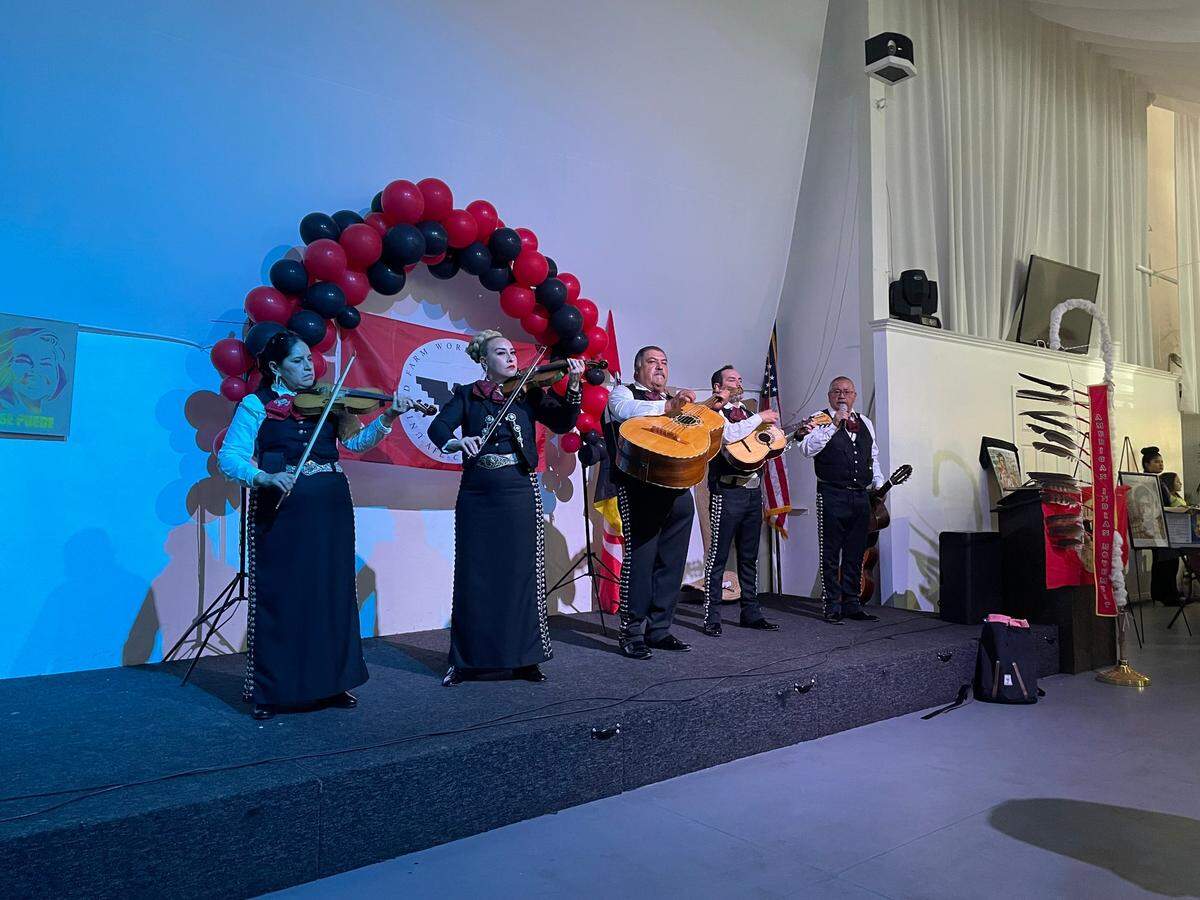
Mariachi music and speeches were the soundtrack as the 25 full-time marchers made stops in Stanislaus County last week. Other volunteers and leaders, like the Diocese of Fresno, have joined the route, too, as they travel to Sacramento. Though organizers and Modesto city officials were at odds over the use of Cesar E. Chavez Neighborhood Park, the mood was celebratory as the marchers descended on the Red Event Center downtown on Thursday.
.
.jpg "IMG-1428 (1).jpg")
The event was among many stops along a 335-mile march the UFW organized to push Gov. Gavin Newsom to sign Assembly Bill 2183. It would amend the California Labor Code to allow farmworkers to vote by mail or by dropping off their ballots at designated locations. Currently, union elections must take place under a supervised process at a physical location, often the workplace.
Voting by mail has worked in general elections and has improved participation, said Teresa Romero, 64. “Why can’t we do it for farmworkers?”
Romero and Maldonado Mendoza were sitting near each other at tables decorated in the red and black colors of the UFW flag. They may share the same first name — my “tocaya,” my namesake, Romero said affectionately — but they lead different lives. Romero is the executive director of the UFW. She’s a former businesswoman and the first Latina and immigrant woman to lead a major union. Maldonado Mendoza picks and washes crops near Bakersfield to make ends meet, and like many farmworkers, she is undocumented.
Maldonado Mendoza volunteers with the UFW but does not work on a union farm herself. “People don’t want to unionize because they fear reprisals, threats,” she said, speaking of her community. She said she believes voting by mail would make other farmworkers feel more comfortable to express themselves than going to a location, especially if that location is the workplace.
The California Farm Bureau disagrees. Instead, the group argues, this bill could actually increase intimidation by an employer or a union because of the way the mail-in voting would be structured. Bryan Little, director of employment policy at the California Farm Bureau, said what AB 2183 would do differs in a number of ways from the mail-in voting in general elections.
If the bill passes, he said, “the union gets to decide who gets to vote in the elections. They get to decide what the date of the election is.” That’s because the bill allows unions to distribute ballots to whoever they choose, at any time, and can deliver them to the labor relations board at any point 12 months after a ballot is signed.
Moreover, Little said, the bill will charge employers up to $10,000 every time they infringe on the employees’ unionization efforts. If employers wants to challenge those accusations, they will have to post a bond equal to the value of the charges. “Imagine having to pay your traffic ticket upfront if you want to appeal it,” he said, “only it’s a lot more than a traffic ticket we’re talking about.”
With those arguments in mind, the California Chamber of Commerce and 24 other local chambers issued a letter to the California Legislature, calling the bill a “job killer.” The Modesto Chamber of Commerce did not join the letter and declined to comment for this article.
Last year, Newsom vetoed a similar bill, AB 616, and alluded to some of the Farm Bureau’s concerns. He cited “inconsistencies and procedural issues related to the collection and review of ballot cards.” The new bill has some minor revisions but is substantively the same.
Still, the UFW is persistent. “We have the ‘si se puede’ attitude,” said Romero.
Their movement is gaining support from others, too. On Saturday, Martin Luther King III, California Labor Federation Executive-Secretary Lorena Gonzalez and two grandsons of Cesar Chavez joined the marchers in Manteca and Stockton.
King, oldest child of slain civil rights leader the Rev. Martin Luther King Jr. and his wife, Coretta Scott King, delivered rousing comments Saturday at a Manteca rally before joining the march for several miles.
“It shouldn’t just be you walking, it should be many of us walking,” said the 64-year-old. He said the march can show the nation “the unfairness of what it is to have someone working so many hours, almost as equivalent to what slavery was.”
King told listeners that the United States of America “certainly is not united at this moment. But when we come together, the true strength is realized and true change occurs.”
Neither the UFW nor the Farm Bureau can predict how Newsom will act this time around. Little speculates that the governor may be thinking differently this time, especially if he is considering a run for president. For the UFW, progress is ”poco a poco,” or little by little, said Romero.
This story was originally published August 20, 2022 at 6:00 AM with the headline "UFW marchers seeking union election changes make Stanislaus stops on way to Sacramento."