
Why do so many people fail the California DMV written exam?
Francisco Moralez went to the Sacramento Department of Motor Vehicles office on a Monday in late June with hope that he would pass the written driver’s test. Rather than leaving with a standard five-year driver’s license, he exited with a 60-day extension on his expired license, a grace period that could keep him in the driver’s seat and give him more time to study.
“I thought it wasn’t that difficult, but I think I got more nervous, more stressed, and missed more than I did the first time,” Moralez said of the computerized test.
Moralez joins more than half of Californians who annually fail the test. Those who have attempted the test over the past two decades have an average failure rate of 51.5%, according to a DMV spokesperson. The rate, however, has been inconsistent over the years. About 39.5% of new applicants and 58% of renewal applicants failed on their first try, according to a statewide evaluation of the written test from 2007. The fail rate did not decrease substantially over multiple attempts. The DMV concluded that the issue was the test itself. The department recommended revising or replacing any potential problematic questions, according to the report.
Still, the written driver’s test remains a barrier or hurdle that must be cleared by California residents who want to get behind the wheel legally.
Moralez, 73, started his driver’s test saga after his license expired earlier during the pandemic. At the height of the pandemic shutdown, the DMV offered a 120-day extension on soon-to-expire driver’s licenses held by Californians age 70 and older. The DMV also asked California law enforcement to refrain from citing younger drivers with a clean record if their license or vehicle registration had expired in fewer than 60 days.
Drivers can be required to retake the written test if they have a poor driving record or a history of crashes. Also, drivers over 70 years old are required to take the test at the time of renewal. The DMV generally notifies drivers on whether or not they need to take the written test when they send their renewal notice.
For new drivers, the written test is a rite of passage on their path to earning a driver’s license. New California residents are also required to pass the written knowledge test rather than having the option to simply transfer their out-of-state license.
Moralez, who was required to take the test to renew, took advantage of the DMV’s new at-home testing option, which has been offered since March to first-time test takers over the age of 18 and eligible renewals. In fact, Moralez made his first two pass attempts at home in a single day. Although generally the test can only be taken once every 24 hours, he had received a new test link in his email shortly after his first failure and went right into taking the test a second time.
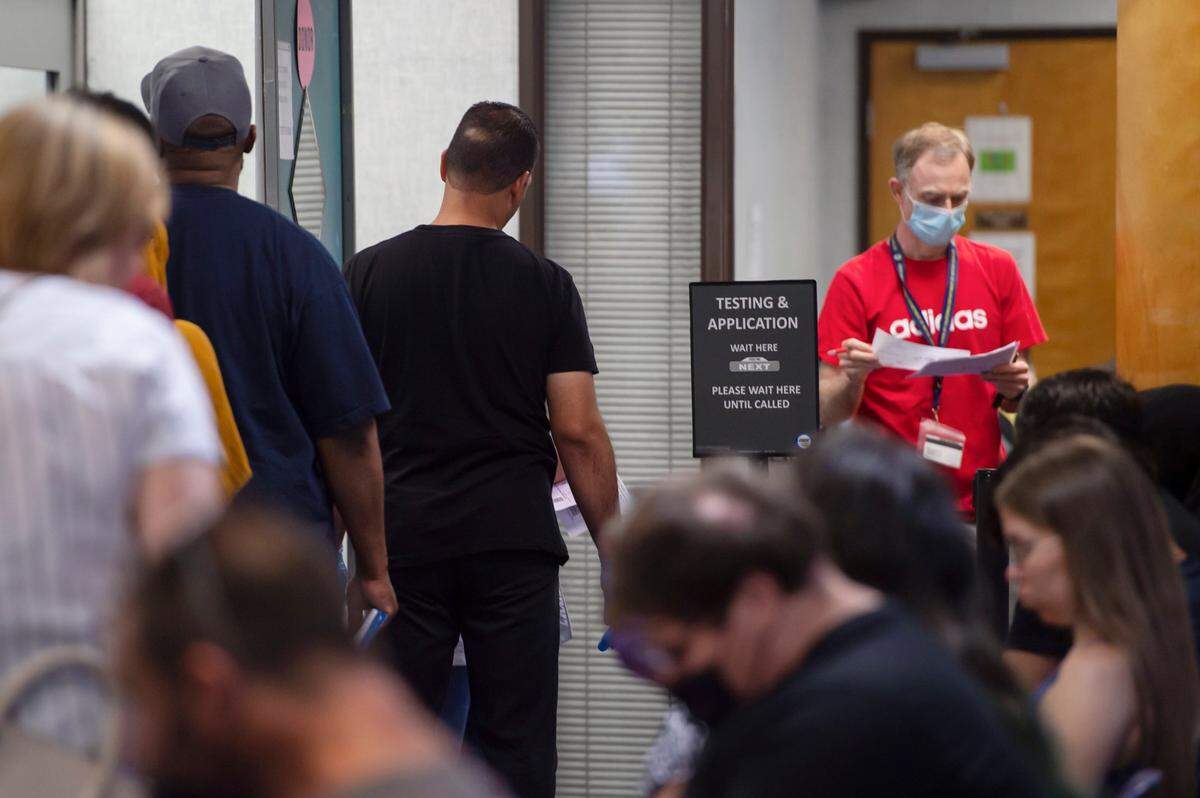
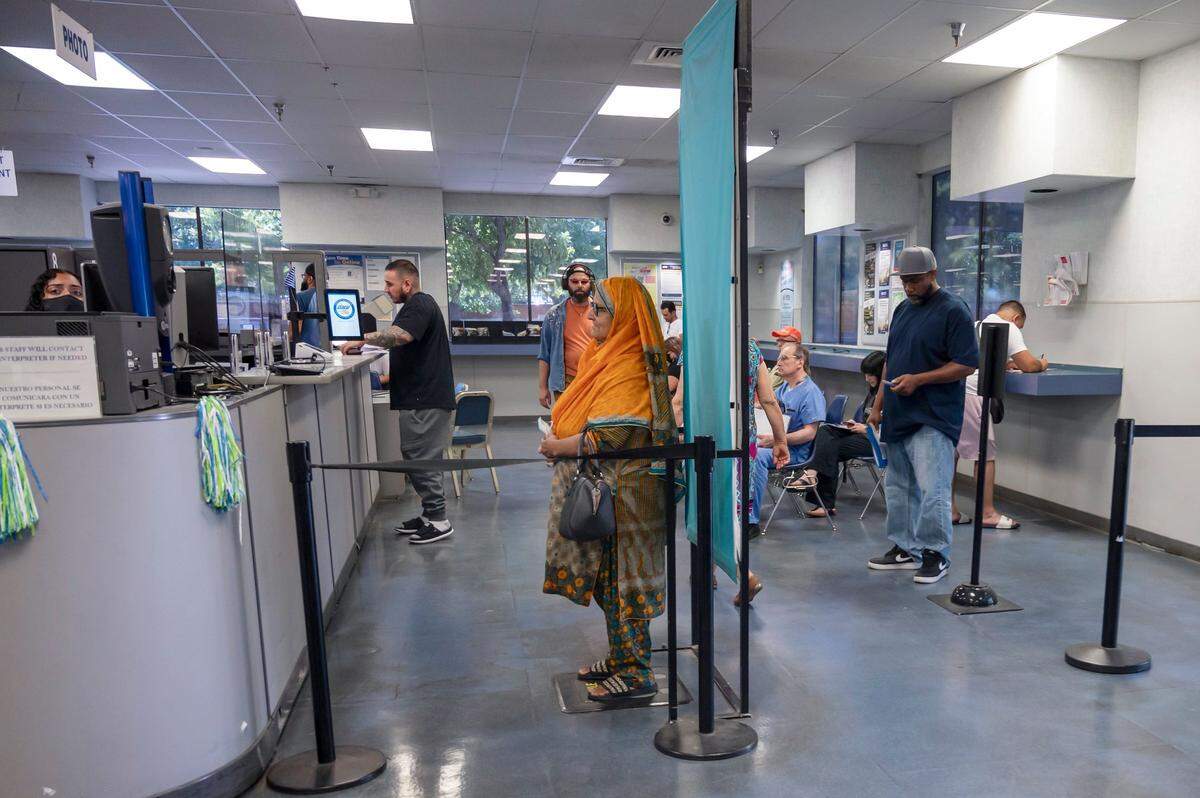
Since he had failed the test twice at home, the DMV required he make his third attempt in the office. Moralez spoke about his experience as he left the busy office with his extended license in hand. Failing the test again meant that he had to restart the application process and pay another $39 fee.
“Some of the questions are kind of tricky,” Moralez said. “Like the difference between ‘must,’ ‘required’ and ‘mandatory.’”
The DMV declined to provide test questions that demonstrated this phrasing, but a sample question from the practice tests offered on the DMV website asks “A large truck is ahead of you and is turning right onto a street with two lanes in each direction. The truck:”
a) May complete its turn in either of the two lanes.
b) May have to swing wide to complete the right turn.
c) Must stay in the right lane at all times while turning.
If you answered b, you’re correct.
In the past year, the average fail rate for the non-commercial driver’s license knowledge test was 56.9%, according to the DMV. This was an increase of 17% from 2020. The DMV, in a statement, said that the COVID-19 pandemic may have impacted the failure rate and cited possible factors such as more people taking the test at home. They did not offer an explanation as to why taking the test from home would be related to a jump in the failure rate. They did note that the department is always evaluating the fairness of the test.
“The DMV takes exams seriously and has upgraded the exam and our processes to ensure they are accurate in their assessment and fair to all. Ensuring the knowledge exam is accurate and fair to all helps confirm that drivers have the knowledge needed to safely operate a vehicle,” said Andrew Finkel, a spokesperson for DMV, in response to how often the department reviews and updates the test questions.
History of the written driving test
In 1908, Rhode Island became the first state to require driver’s license examinations, according to the Federal Highway Administration.
Five years later, New Jersey became the first state to require applicants to pass both a written test as well as a behind-the-wheel exam. The test consisted of seven to eight questions designed to test the applicant’s knowledge of the rules of the road and the car’s mechanisms.
“I confidently believe that other states will follow New Jersey’s lead, and that the results will be fewer accidents and better road conditions,” Job H. Lippincott, the state’s motor vehicle commissioner, said at the time.
California began requiring licenses in 1913 and written exams in 1927. W. B. Manford, of the Stanislaus County traffic department, was sent to administer the tests across the state.
“All drivers who fail to have an operator’s license are guilty of a misdemeanor,” Manford said in a 1927 Orville Mercury Register article. “It is imperative that they have cards.”
Testing has come a long way since Manford’s pop-up testing clinics.
Electronic tests were made available beginning in 2012 and became statewide in 2014.
This year, the DMV started using a linear-on-the-fly testing algorithm, otherwise known as LOFT, to help evaluate and manage the difficulty of the test. LOFT strives to achieve increasingly more consistent pass/fail rates across all the tests offered by the DMV. The algorithm also tells the DMV when current questions are too hard and need to be rewritten.
.JPG "SAC_xm0709traffic030020 (1).JPG")
The test currently has a multiple-choice format, with three possible answers for every question. When the fail rate was 63.9% among Californians in 1998, the department changed the format from four to three possible answers.
Some states, like Utah, still have four possible answers. Utah’s test is also open-book.
A DMV spokesperson said that the department’s most recent testing changes are based on the rewritten driver handbook, which was designed to be more reader-friendly and easier to navigate. The DMV also just added Assyrian, which brings the total to 36 languages in which the test is offered.
Taking the driver’s test in another language
The California DMV works to ensure that test takers are not hindered by a lack of English skills.
Ensuring the fairness of non-English tests has required review and adjustments on the part of DMV officials. For example, a review of fail rate among Spanish-language test takers in 2007 showed it was higher than English test takers at 73.4% for new applicants and 71.6% for renewal applicants. The department recommended a review of the language translation as well as making the Spanish version of the California Drivers Handbook more widely available.
The DMV applied the report’s suggestions, according to a spokesperson, and rephrased some questions to remove potential confusion. The department has not made any additional evaluations of the Spanish-language test since, according to the DMV. The fail rate of people who took the test in Spanish over the past year was 74.8%.
Among the most popular languages, Japan has had the highest pass rate from 2020 to 2022 at 73.2%.
Psychology of taking the test
Henry Roediger, a professor of psychological and brain sciences at Washington University in St. Louis, said cramming for the written test isn’t effective for long-term retention of road laws. For example, testing yourself with flashcards rather than just reading through the handbook forces you to consider what you already know and what you don’t.
“Gotcha questions” that try to trick test-takers are shown to diminish the effectiveness of the test, he added.
“Some of the questions are pretty obscure,” Professor Roediger said of driver’s tests. “You read it in the book, and you have to know it from there, but it’s not anything you’ll ever need to know on the road.”
Henning Mortensen, owner of the Bond Driving School in Sacramento said, “They are intentionally tricky. I think the DMV sets up students to really challenge them.”
Sadaf Samim, 18, was preparing to take the test for the first time. She completed driver’s ed while in high school and had been studying for the past week.
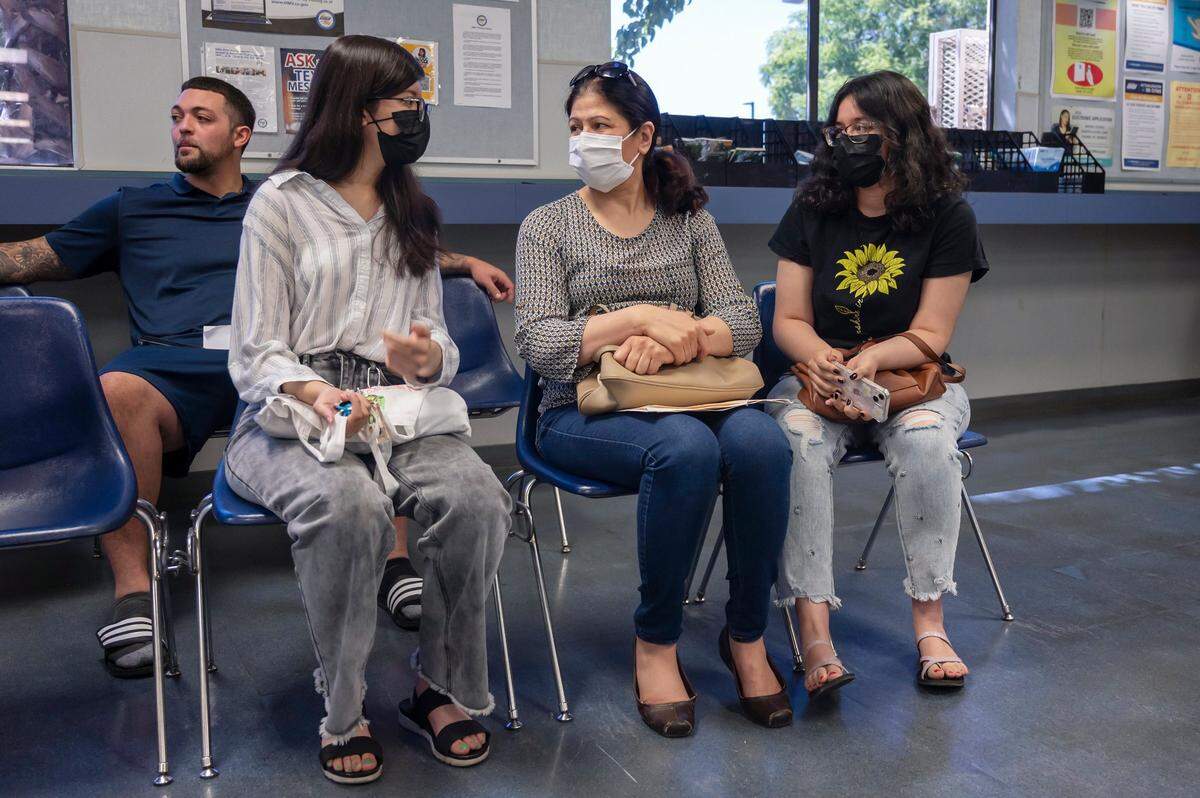
She said she was nervous going into the test but felt as though she did as many practice tests as she could.
Her sister, Sahar, who had been waiting with her at the DMV alongside their mom for nearly three hours, got her license back in 2019. While helping her sister prepare, Sahar, 21, noticed that the practice questions and handbook don’t reflect how people actually drive.
“It’s a dumb test,” Sahar said.
Mortensen recommends opting for the paper test over the computerized one since you can go back to the questions and you won’t be alerted every time you get an answer wrong. His students end up passing at a higher rate this way, he said.
Driver’s test study trick: Handbook over practice tests
Many prepare for the test by reading through the handbook or taking the practice tests offered online. Moralez feels as though the practice tests only cover one-eighth of what’s on the actual test.
One of Mortensen’s students, Gabe Johnson, 15, passed on his third try. The minimum age requirement for taking the written test in California is 15 and a half. He opted for the paper test on his second and third try and found that reading through the handbook helped a lot more than taking the practice tests.
“I underestimated it by a lot,” Gabe said about the test.
Mortensen said many of the questions are framed in a confusing manner to see if applicants are following directions instead of if they know the answer.
Most of the time, students don’t understand the context or implications of the information they are studying until they are behind the wheel, Mortensen added.
“That’s when it clicks for the students,” he said.
This story was originally published July 20, 2022 at 5:00 AM with the headline "Why do so many people fail the California DMV written exam?."