
Historic report details harm to Black Californians. Here are 5 takeaways from reparations study
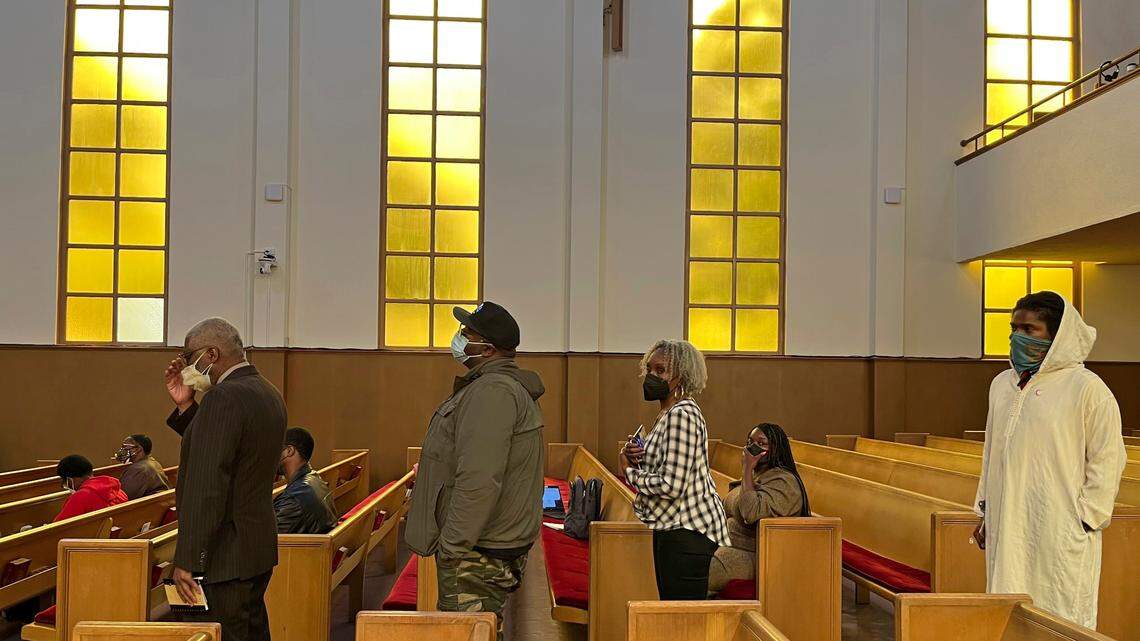
A California commission charged with investigating whether the state should provide reparations to Black residents released a report last week that explicitly connects state policies to harm against African-American communities and recommends steps the government could take to address disparities.
The California Reparations Task Force to Study and Develop Reparation Proposals for African Americans submitted its executive interim report to the California Legislature detailing the lasting effects of enslavement and discriminatory policies, such as disparities in household wealth and public health.
“Without a remedy specifically targeted to dismantle our country’s racist foundations and heal the injuries inflicted by colonial and American governments, the ‘badges and incidents of slavery’ will continue to harm African Americans in almost all aspects of life,” the report says.
The committee, established by a 2020 law signed by Gov. Gavin Newsom, in March passed a resolution urging the state to provide reparations to descendants of enslaved people and Black families who can trace their lineage in America to the 19th century. It rejected an alternative proposal that would have urged the Legislature to provide reparations to all Black Californians.
The new report goes further in detailing present-day inequalities and recommending programs the state could adopt to address the lasting effects of discriminatory practices. Here’s a look at five key issues the report raises and the committee’s recommendations for policy changes.
Criminal justice disparities
California entered the Union in 1850 as a free state, but its early policies supported enslavement, the report says. An estimated 1,500 enslaved African Americans lived in California by 1852. And just like in the South, enslaved people in California faced brutal violence.
In 1852, California passed and enforced a fugitive slave law that required citizens to capture enslaved Black people and return them to their enslavers.
The study connects that history to modern law enforcement practices, which disproportionately criminalize Black people and African-Americans.
Those practices led to the over-policing of Black neighborhoods, the mass incarceration of Black Americans, and other inequities in the legal system. In 2017, Black men accounted for 28.5% of the California’s male prison population despite making up just 5.6% of the state’s adult residents, according to Public Policy Institute of California report.
“Like the rest of the country, California stops, shoots, kills, and imprisons more African Americans than their share of the population,” the reparations report says.
The task force recommends a comprehensive reparations scheme to confront disparities in criminal justice, including establishing an office to offer a range of free legal services and to advocate for civil/criminal justice reforms.
Political disenfranchisement
California’s early state government also passed laws to prevent Black and other nonwhite Californians from accumulating political power. For instance, California in 1851 prohibited non-white people from testifying in any court case involving white people.
The California Supreme Court in an 1854 decision described the prospect of allowing people of color to testify against white people in court as an “actual and present danger” that could lead to expanded voting rights for nonwhite citizens.
“We might soon see them at the polls, in the jury box, upon the bench, and in our legislative halls,” the court wrote.
California did not allow Black men to vote until 1879, although it adopted voter-suppression laws. California prohibited individuals convicted of felonies from voting, added a poll tax, and put in place a literacy test.
The task force recommends establishing an Office of Freedmen Political Affairs to support ongoing political education on African American history, to support political activity for African American youth, and to support forums that amplify African American political candidates.
Separate and unequal education
In 1874, the California Supreme Court ruled segregation in the state’s public schools was legal, 22 years before the U.S. Supreme Court’s infamous “separate but equal” case of Plessy v. Ferguson.
Later, after the U.S. Supreme Court overturned Plessy and prohibited segregated education, disparities persisted in California schools, the report notes. California voters in 1979 passed an anti-busing initiative, which limited efforts to turn back segregation in public schools.
Today, California, schools mostly attended by white and Asian children receive more funding and resources than schools mostly attended by Black and Latino children, the report says.
The commission also highlighted disparities in student discipline, with Black and brown children facing punishment more often than whites. It cited recent California Department of Justice investigations into several local school districts that showed Black students facing discipline at higher rates than other races.
Sacramento-area school districts, while not cited in the reparations report, have suspended more Black students than any other district in California, according to a recent study. Elk Grove Unified School District and Sacramento City Unified School District were listed first and fourth according to data from the “Suspending Our Future” survey released by the Black Minds Matter Coalition in 2019.
To rectify this, the task force recommends free tuition for African-American students to attend better schools, whether K-12, college, or trade school. For teachers and administrators, the commission requests anti-bias training and recruitment of Black educators and administrators.
Housing segregation and health
Discriminatory federal housing policies, local zoning ordinances and decisions on where to build schools drove Black families to unhealthy neighborhoods, the report notes.
In general, the policies blocked Black Americans from living in suburban towns and forced them to live in industrial areas. Black people who lived in more affluent areas in some cases were moved out by racial terror tactics or forced out in the name of building parks and other infrastructure.
Today, Black neighborhoods have more exposure to hazardous waste, oil and gas production, and automobile and diesel fumes, and are more likely to have inadequate public services like sewage lines and water pipes. Black neighborhoods also are least likely to have a tree canopy.
Compared with white Californians, Black Californians are more likely to have diabetes, die from cancer, or be hospitalized for heart disease. Black Californians suffer from high rates of serious psychological distress, depression, suicidal ideation, and other mental health issues. Black Californians have the highest rates of attempted suicide among all racial groups.
Unmet mental health needs are higher among Black Californians, including lack of access to mental health care and substance abuse services.
The task force urges statewide investments in environmental infrastructure to create shade equity, minimize heat islands, and create equal access to parks, land, and natural resources in Black neighborhoods. It further recommends reversing the effects of anti-Black health care laws and policies and anti-Black discrimination in health care by compensating individuals whose mental and physical health has been damaged by the anti-Black health care system.
The wealth gap
Government policies that supported enslavement have helped white Americans accumulate wealth, while creating barriers preventing Black Americans from doing the same.
Federal and California Homesteading Acts essentially gave away hundreds of millions of acres of land almost for free mostly to white families. California’s homestead laws similarly excluded Black Americans prior to 1900 because they required a homesteader to be a white citizen.
Later, as discriminatory housing policies took root, Black Californians lost opportunities to build wealth through home ownership.
As a result, the wealth gap between Black and white Americans persists decades after the civil rights reforms of the 1960s. In 2019, the median Black household had a net of $24,100, just 13% of the median net worth of white households at $188,200, the study notes.
To reverse this, the task force recommends establishing an office of Freedmen Business Affairs to provide ongoing education related to entrepreneurship and financial literacy; business grants; and new public-private partnerships.
This story was originally published June 6, 2022 at 5:25 AM with the headline "Historic report details harm to Black Californians. Here are 5 takeaways from reparations study."
