
Gavin Newsom’s recall-year budget would pour tens of billions of dollars into struggling economy
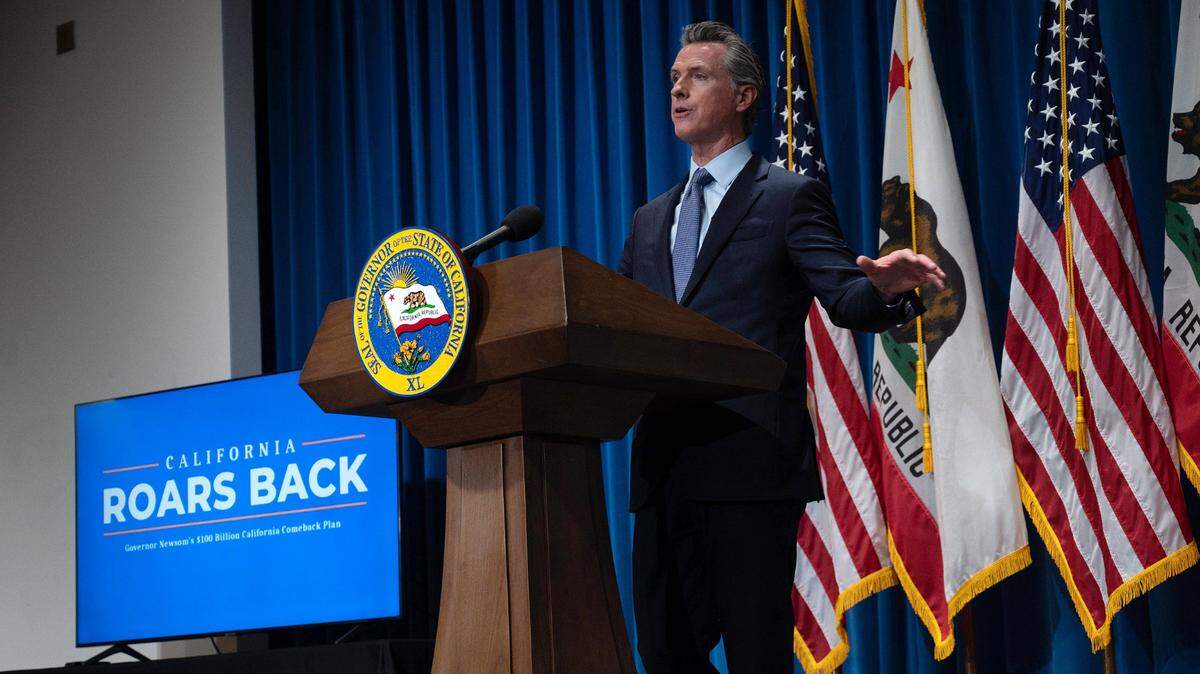
Gov. Gavin Newsom on Friday proposed pouring tens of billions of dollars into California’s struggling economy as part of a record-setting state budget proposal that will play out as he defends himself in a recall election.
The $267.8 billion plan would direct billions in spending toward stimulus checks for Californians, give millions of children a start on college savings accounts and provide grants of up to $25,000 apiece to businesses set back by COVID-19.
His plan, which proposes $196.8 billion in general fund spending, also includes massive efforts to modernize the state’s roads, bridges and broadband.
It would essentially create a new grade in California public schools called transitional kindergarten and expand child care slots. It would also expand eligibility for Medi-Cal, the state-funded health program for low-income people, to undocumented people over age 60.
And it would put $24.4 billion into reserve accounts, including the so-called Rainy Day Fund that gives lawmakers a cushion when revenue falls.
“This is our plan to get California not only back on its feet, but California roaring back, once again, to its rightful status as the most essential and dominant state, not only in the United States, but one of the most essential modern economies anywhere in the world,” Newsom said.
It’s a stark turnaround from a year ago when he and lawmakers slashed tens of billions of dollars in planned spending and cut public employees’ pay as they braced for a severe recession.
The coronavirus downturn didn’t happen to the extent Newsom anticipated. Instead, the state’s high-earners tended to do well during the coronavirus pandemic, while low-income people bore the brunt of the economic hardship.
Now, his plan is on built on a $75 billion surplus from tax revenue and another $27 billion in stimulus funds from the federal government. He credited the people of California for “this historic, unprecedented, generational and transformational budget.”
Roads, health care, stimulus checks and more
Newsom over the past week toured the state announcing big-ticket budget items, earning applause from Democratic allies during his daily stops that, at times, seemed like a campaign tour.
Republicans have panned some of the proposals, accusing Newsom using the surplus to bolster his chances in an expected recall election this year by sending checks directly to Californians.
Newsom is proposing sending $600 checks for individuals making less than $75,000 and an additional $500 to families.
By law, the size of California’s budget is determined by tax revenue, not by Newsom, although political experts say he’ll likely benefit from the surplus money he’ll be able to spend.
State law will also likely require state government to send some money back to taxpayers anyway because revenues are so high, and Newsom’s administration says it plans to use the stimulus checks he’s proposing to satisfy that requirement.
Some Republicans argue that those checks don’t go far enough, and that Newsom should propose actual tax cuts, which he has not done. Former San Diego Mayor Kevin Faucloner, who is running to replace Newsom as governor, released an income tax cut proposal this week as a contrast to Newsom’s spending plans.
U.S. Senate Republican Leader Mitch McConnell has pointed to California’s budget surplus as evidence Congress should not have sent so much stimulus money to states.
Newsom’s budget proposal uses the state’s surplus and the federal stimulus money for $100 billion in economic stimulus programs, including $7.2 billion to help low-income tenants make rent and utility bills they missed during the pandemic and expanded aid for small businesses.
Newsom also wants to spend $12 billion to alleviate homelessness, one of the most stubborn problems in California. Most of that money would go to expand a program Newsom launched during the pandemic called Project Homekey that gives local governments money to purchase hotels and other buildings that they can convert into supportive housing to get people off the streets.
Among the other big proposals in Newsom’s budget plan:
▪ $11 billion to modernize California’s roads, bridges and public transportation, as well as to continue construction on high speed rail and build infrastructure for the 2028 Olympics in Los Angeles
▪ $7 billion to expand broadband access to underserved communities
▪ $3.2 billion to increase zero-emission vehicle use, as well as $1.3 billion to prepare the state for extreme heat and rising sea levels caused by climate change
Kicks off budget negotiations
Newsom and lawmakers have a month to negotiate details of the 2021-22 budget. Lawmakers must pass a budget by June 15 for Newsom to sign into law before the fiscal year begins July 1.
Democrats who control the Legislature have already signaled they agree to at least the spirit of Newsom’s economic stimulus proposal, which they’ve framed as a way to use money from the state’s richest residents to help low-income people who were hurt by the coronavirus-fueled economic downturn.
“Thank goodness California is in the position to make transformative investments to end family homelessness, lift those hurt by the pandemic and properly fund our schools. Gov. Newsom’s proposed budget does that and more, and complements the state Senate’s priorities,” said Sen. Nancy Skinner, D-Berkeley.
Senate President Pro Tem Toni Atkins, D-San Diego, called the strong economic projections “an opportunity to create transformative change” and build an inclusive post-pandemic economy.
“It’s promising to see Gov. Newsom aligned with us on many of the ways we can accomplish that goal,” Atkins said in a statement. “The Senate will come to the table ready to champion the needs of Californians.”
But Republicans are pushing back against Newsom’s plan. Assemblyman Vince Fong, a Bakersfield Republican and vice chair of the Assembly Budget Committee, said the $75 billion surplus “is the clearest indication that Californians are over-taxed” and called for that “tax burden” to be “permanently reduced immediately.”
“We do not have a revenue problem in our state,” Fong included in his statement. “We have an incompetent government that cannot fix the basics in our state. We need a new direction that actually achieves real results for all Californians.”
Hannah Wiley of The Sacramento Bee Capitol Bureau contributed to this report.
This story was originally published May 14, 2021 at 10:30 AM with the headline "Gavin Newsom’s recall-year budget would pour tens of billions of dollars into struggling economy."