
This mom protested vaccines, then started a ‘militia.’ How California extremism is changing
In the spring of 2019, a trio of women set out to block new vaccine rules for California’s public school kids. Fueled by online conspiracy theories and misinformation, they disrupted legislative hearings and enlisted their friends to barricade the state Capitol entrance.
The group, dubbed the Freedom Angels, had by the spring of 2020 turned its attention to the COVID-19 pandemic and statewide shutdown orders. Some of them joined a crush of far-right protesters pushing against a phalanx of California Highway Patrol officers in a failed attempt to gain access to the Capitol. It led to one of the most striking images of that fractious day.
Those vocal and angry demonstrations helped land the Freedom Angels on a state law enforcement threat monitoring list alongside the white nationalist group Proud Boys, California militia squads and other far-right extremist coalitions.
And now, a Freedom Angels co-founder, Denise Aguilar, has formed her own splinter group — which she’s calling a “Mamalitia” of “community squad leaders” — with the goal to train women in firearms, self-defense and natural medicine. The group, also on the state’s radar, hosts meetings throughout California to teach women how to grow food, homeschool kids and operate guns.
Aguilar’s evolution from an activist decrying vaccine mandates in the name of motherhood to the founder of a self-described militia of survivalists has been swift.
But it doesn’t surprise experts who study the anti-vaccine movement and extremism.
While their activism is still considered “fringe,” their rhetoric shouldn’t be shrugged off by elected officials or public health professionals, said Richard Carpiano, professor of public policy and sociology at University of California, Riverside.
“You can’t just blow them off as being these wacko people,” Carpiano said. “They are serious. They do have impact, and now to the extent that they are courting groups that are much more fringe and invoking this militarized rhetoric that implies a potential use of force.
“It only takes one person to do something bad,” Carpiano said. “You could see how this could potentially stoke something.”
Mamalitia’s website depicts nearly a dozen women armed with handguns and rifles, and boasts a selection of courses in reading maps, home protection and first-aid trauma treatment.
“The tyrants have created women who are ready to go like it’s 1776,” the website’s landing page reads.
Aguilar was, according to her social media posts, in Washington, D.C. on Jan. 6, when a violent coup stormed the halls of Congress, though there’s no evidence she was among those who breached the building or clashed with officers.
She describes herself on social media as a mother of three, pro-gun, pro-small government, Christian, and “pro body sovereignty,” meaning she makes medical decisions for herself and her family without “the coercion of pharma.” She also claimed in an Instagram video to be a former gang member.
In October, law enforcement analysts with the California State Threat Assessment Center — a coalition of state law enforcement groups — flagged the Freedom Angels and Mamalitia protest plans outside the state Capitol, records reviewed by The Sacramento Bee show.
In daily bulletins, the wide-ranging assessments alerted field officers to threats of violence and cyber risks as well as routine and peaceful gatherings and marches. The records often describe crowd sizes based on Facebook pages and kept tabs on scores of groups’ planned demonstrations, from Black Lives Matter protests in Southern California to “Stop the Steal” and Antifa rallies in Sacramento.
For weeks around Election Day, the state’s analysts noted the Freedom Angels and Mamalitia affiliations with other far-right demonstrators, calling them the “Mom Militia.” (Aguilar initially referenced the group as “Mom Militia” when she established its Instagram page last fall.)
At one point, an analyst wrote, the Freedom Angels were working in tandem with the Proud Boys, “who have provided security in the past” for their events.
“So thank you to the Proud Boys,” Aguilar told a crowd of cheering demonstrators waving Donald Trump flags outside the California Capitol in November. “I’ve worked with them. I know them. I love them. I trust them. And I trust them so much that they’re here protecting you. And thank you to the California militia guys out here as well.”
The California Office of Emergency Services, which provided the documents to The Bee in response to a Public Records Act request, runs the threat assessment center with the state Department of Justice and Highway Patrol.
Brian Ferguson, an OES spokesman, declined to discuss specifics about the state’s surveillance tactics or details about any specific group, but said officials are “constantly looking” at how to “evolve our strategies for countering extremism.” He said details that analysts collect and share “serves to provide actionable information to aid state, local and federal law enforcement officials in deterring violence and criminal activity.”
“I would also note that, inclusion of social media posts from individuals or groups in situation reports does not on its own represent any wrongdoing and in most cases is protected speech under the First Amendment,” he said.
The Freedom Angels and members of Mamalitia haven’t been tied to any violence, and there’s no evidence any of the other women in those groups stormed the U.S. Capitol on Jan. 6. The state has not yet provided additional, more recent records to The Bee.
It’s clear, though, that tensions over racial unrest, pandemic lockdowns and lies about a stolen 2020 election peddled by then-President Trump and his followers have brought together a mix of radical bedfellows over the last year. Anti-vaccine activists began protesting beside small-government conservatives and traditional far-right militia groups.
Together, said Brian Levin, director of the Center for the Study of Hate & Extremism at San Bernardino State University, they rode the “coattail of grievance.”
“There was this mingling that took place throughout 2020,” Levin said. “And then we started seeing folks associated with the anti-vax movement, for instance, really cross-pollinate with other grievance-oriented folks, including extremists.”

‘Survivalists and preppers’
On a recent sunny Saturday, a group of around a dozen women, most of them in their 30s or 40s, sat at picnic tables at a suburban park in Elk Grove. Surrounded by newer stucco-sided homes, they were listening to a woman wearing a brown T-shirt tucked into a pair of brown baggy pants, not fatigues exactly, but military-chic.
Kids nearby climbed on the playground equipment. One woman not with the group sat on a park bench. They were seemingly oblivious to the fact a militia group was having a meeting a few feet away.
This was a Mamalitia “meet and greet,” one of several promoted on its website and held across California this month.
The woman in the brown pants was Aguilar, who declined multiple requests for comment for this story. She has said in a social media post that Mamalitia has garnered “hundreds of members across the United States.” Those numbers are impossible to independently verify, though it is clear that Aguilar is recruiting across the country.
The group’s website regularly adds new locations. As of April 28, the website claims to have chapters in nearly 20 California counties, from Sacramento to San Luis Obispo to San Diego. Three counties in Idaho — Benewah, Twin Falls and Ada — are listed as having chapters. The website also says Mamalitia is in Washoe, Clark and Douglas Counties in Nevada, as well as New York, Pennsylvania, Michigan, Georgia, Nebraska, Connecticut, Alabama, Arizona, Washington, Louisiana, Montana, New Jersey, Texas and Missouri.
“Our goal is to train women on firearm safety and self-sustainability,” the website reads. “We are looking for leaders across the country who will step into the role to help build our communities up in this time of uncertainty.”
To join the group, women are required to upload an image of themselves and answer a series of questions, like “How long have you been a lover of our country?” and “Define ‘Moral Strength.’”
Applicants are charged $20 for Mamalitia members to conduct background checks.
On social media, Aguilar dismisses labels like anti-vaccine or anti-mask, even though she regularly denounces the COVID vaccine on her pages and defends her right to go maskless. She smiles in her Facebook profile picture as she stands next to a man with a black t-shirt that reads, “F**K THAT VACCINE.”
She also rejects any claims that Mamalitia members are “trying to go out and cause violence.” On its website, the group blames a “lack of interviews’‘ for it being “misconstrued as violent.”
When a Sacramento Bee reporter walked up and requested an interview while at the Elk Grove meeting, Aguilar turned him away.
“I actually don’t do interviews,” she said. “Can you give us a little bit of space?”
A few minutes later, Aguilar followed the reporter to his pickup and inspected its rear license plate.
On social media, Aguilar said Mamalitia members learn to hunt, fish and set up their own schools. They study maps and compasses in case the grid ever goes dark. They grow their own herbs and mix “tinctures, salves and teas,” according to the group’s website.
The Mamalitia website features photos of women canning food, disassembling a rifle and children shooting bows and firearms. In one picture, a woman is wrapping a bandage around a child’s arm.
A group of 11 women pose before a setting sun in another photo — this one taken by what appears to be a professional photographer — armed with rifles.
In another, Aguilar is standing in a field with a setting sun in the background and holding an AK-74-style rifle with tactical modifications. A large magazine is in the weapon. She has two more magazines in a tan tactical vest, worn over her floral-patterned purple and pink dress. A semiautomatic handgun is in a holster on her right hip.
“We are survivalists and preppers,” Aguilar said in a video posted to her Instagram account, using a term for people that prepare and stockpile supplies to survive a disaster.
“I can tell you with all of my activist instincts and all of the experience I’ve had with the politics in California, that something is brewing here,” Aguilar said in another video. “With all that’s happened in 2020 and seeing how unprepared people are, how unprepared families are, I started Mamalitia. It’s a group of women from across the country. We are preparing.”
Bricks and menstrual blood
Sen. Richard Pan isn’t shocked by the news that the Freedom Angels was listed on a state protest and extremism-monitoring watch list, or that Aguilar’s new venture is a women-only militia.
The Sacramento Democrat and pediatrician has penned several of California’s tough vaccine laws. During his tenure in the Capitol, he’s faced death threats and physical violence for his legislative efforts to limit who can skip shots in the Golden State.
During the latest debate in 2019 over a bill to increase oversight of doctors issuing medical exemptions for California school kids, lawmakers were sent dozens of bricks with messages to vote against the measure. No one was arrested in those cases.
On the final night of the legislative session that year, an anti-vaccine protester named Rebecca Lee Dalelio was charged with felony assault and vandalism after she allegedly threw a cup of menstrual blood on a group of senators from a viewing balcony. The incident cost the Senate thousands of dollars in cleaning after the chamber was declared a crime scene. Her charges remain pending.
Also in 2019, a Sacramento judge granted Pan a restraining order against a prominent anti-vaccine advocate who allegedly shoved the senator while he was walking down a street near the Capitol. The man, Austin Bennett, filmed the incident during a Facebook Live recording. He was later charged with misdemeanor assault. His case also is pending.
In January, several women interrupted a routine budget hearing to threaten lawmakers against pushing vaccines and COVID-19 restrictions.
“If you want to vaccinate everyone in California, you guys are not thinking,” said one woman, who did not share her name. “And there’s one more note: 17 million guns were purchased in the United States ... what do you think they’re going to do with that?”
“Keep threatening us,” another unidentified woman said. “Keep taking our s--- away. Keep telling us we can’t do anything about it and see how much longer we’re going to sit here and wait to give public comment...We didn’t buy guns for nothing.”
Levin, with the Center for the Study of Hate & Extremism, said anti-vaccine activists stand to gain something from these incidents. They garner headlines, cultivate a larger following and monetize off the attention.
The Freedom Angels represent “a larger trend,” Pan added, of a brand of activism that profits off “right-wing extremism.”
“They are constantly fundraising, they always want donations, always looking to monetize,” Pan said. “How do you make more money? You have to get a bigger audience? How do you get a bigger audience? Find other extremists you can align with.”
The Mamalitia site does request donations to help members “travel to train and work in the community.”
Aguilar also solicited donations to help finance her trip to Washington D.C. in January, according to her social media posts.
Her Venmo account was largely dormant until 2019, when she started frequently traveling to Sacramento for protests. That spring and summer, Aguilar started receiving Venmo payments from a list of supporters that included gas money to get to rallies, and supplies for the group’s events. It’s unclear how much Aguilar earned at this time, because the transactions do not include dollar figures. Her transaction history on the app was public until May 1, 2020.
“Gas money, snacks, coffee, water, or food,” one user wrote to Aguilar in a June 19, 2019 payment. “I also paid the $50.00 dollar (sic) donation for a bus seat for a mommy wanting to go up there. Lots of love and prayers.”
Intense rhetoric continues
This year, as vaccine groups became more militia-oriented, other fringe theorists who peddled “stop the steal” rhetoric have embraced anti-vaccine advocacy. Adherents to other conspiracy groups, like QAnon, have latched onto vaccines as a common enemy. As social media companies “de-platform” groups and drive supporters underground, “big tech” becomes an enemy, too.
“The players are known,” Levin said. “The villains to these players are known. And all that changes is what’s going to be the latest grievance that’s on top of the weight?”
“The adherents of these movements are realigning,” Levin said. “And this is what you’re seeing.”
At the same time, the January Capitol riots highlighted how ordinary people can quickly become radicalized. According to one recent analysis of the 423 people arrested for breaching Congress, 87% of them had no apparent affiliation with any known militant organization. They were business owners, and blue- and white-collar workers that the University of Chicago researchers described as “‘normal’ pro-Trump activists” who joined with the far right to form “a new kind of violent mass movement.”
Aguilar’s militia group bills itself as a place for ordinary women.
“The women in our group are homemakers, professionals, influencers and overall liberty protectors,” she wrote on her website. “EVERYONE brings an important piece to this puzzle and our members (sic) voices matter.”
While other extremist groups have largely been deplatformed from social media and gone underground, the increasingly militant anti-vaccine groups are operating in the open, including holding recruitment meetings in suburban parks, and they’re still making their presence known in California’s Legislature.
On April 20, anti-vaccine activist Joshua Coleman spoke at a committee hearing in opposition to legislation that would limit how close protesters could get to COVID-19 vaccine sites.
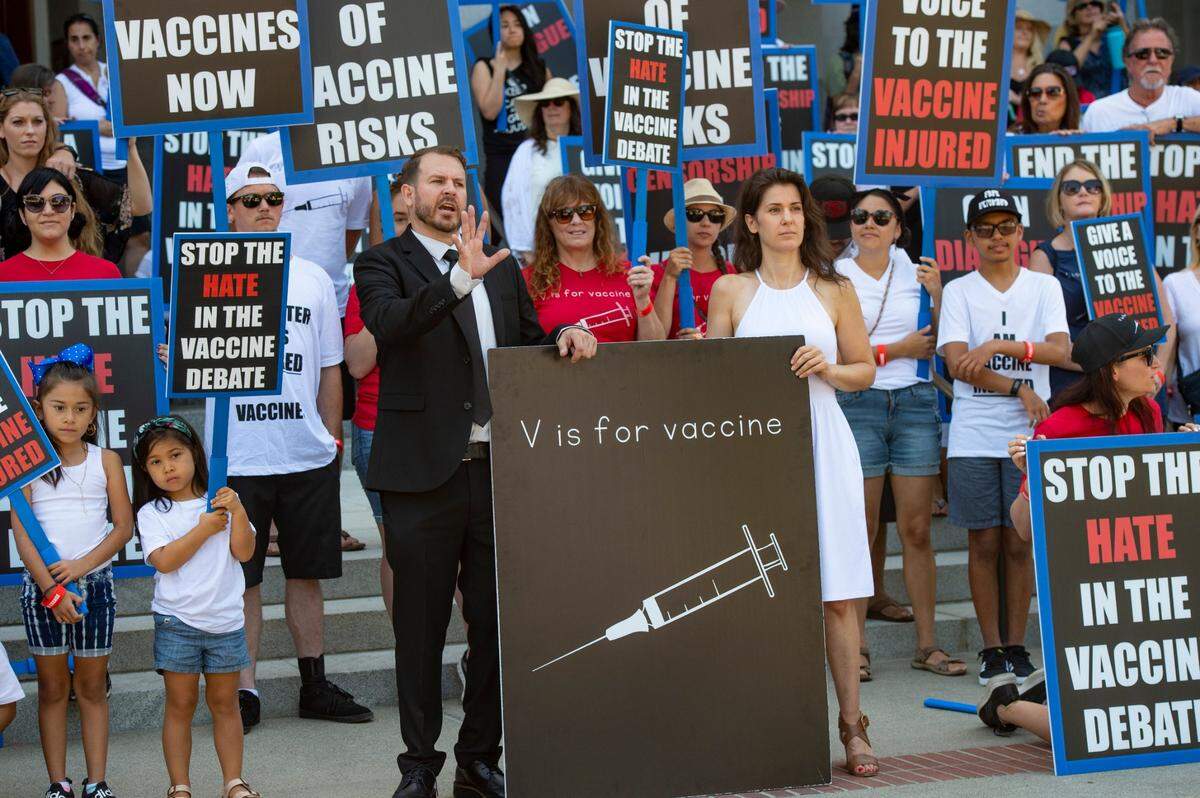
The bill would carry a fine up to $1,000, or six months imprisonment, or both.
Coleman said the members of his movement are getting increasingly fed up.
“If they pass this bill, we are stepping it up,” he said in a Facebook Live video. “We are going to step it up. We are going to make it worse. We are going to be bigger, and we’re going to be louder. That’s what happens. … It’s going to backfire.”
Coleman has misdemeanor eavesdropping charges pending for allegedly surreptitiously recording in Senator Pan’s office in 2017. Coleman’s trial is tentatively scheduled for next month, and his supporters have raised more than $11,000 in online fundraisers to help him fight the charges.
Pan, in an interview with The Bee, said that if the past three years have shown anything, it’s that the country needs to stop pretending extremism lives in the dark corners of the internet. To him, when a group like the Freedom Angels starts arming themselves and making revolutionary threats, they shouldn’t be blown off. Extremist rhetoric can quickly become “real world stuff,” he said.
“The evolution of the Freedom Angels, I think, is a case study for how extremism spreads,” Pan said.
This story was originally published April 29, 2021 at 5:00 AM with the headline "This mom protested vaccines, then started a ‘militia.’ How California extremism is changing."