
California took 35,000 homeless people off the street for 1 year. Did the program work?
It took a pandemic for Bennie Rogers to get healthy, housed and happy.
Rogers, 68, was living in a tent along the river in Old Sacramento last summer when he got the chance to go inside with help from a state-run emergency program set up to house vulnerable homeless people during the COVID-19 crisis.
Rogers was hot. He wasn’t eating regularly. He was tired.
The move out of the tent and into Sacramento’s Vagabond Inn came with privacy and personal space, a hot shower, comfortable bed and three meals a day — like pancakes, oatmeal, juice and coffee for breakfast.
“That’s why this is so different and better for me. I wasn’t doing too good out there,” Rogers said. “But now, I’m healthier just by being here.”

The program that helped him and about 35,000 other homeless Californians during the coronavirus pandemic is expected to wind down before the end of this year. Experts say it could become a model for future efforts to aid the estimated 150,000 homeless people in California, offering a glimpse into what’s possible when politicians act with urgency and provide the necessary resources to quickly get large groups of people off the streets.
“It’s been a tremendous success,” said Dr. Margot Kushel, director of the University of California San Francisco Center for Vulnerable Populations and the Benioff Homelessness and Housing Initiative. “I do think that at the end of the day, it will become clear that this is the main reason we had fewer horrendous outcomes of people who were homeless.”
Before the pandemic, Gov. Gavin Newsom called homelessness “the most pernicious crisis in our midst”. COVID-19 gave him an opportunity to try something seemingly unprecedented.
Using emergency authority, Newsom designated an initial $150 million in March 2020 for local governments to purchase trailers and rent hotel and motel rooms for COVID-19 positive or suspected patients and at-risk people. He called it Project Roomkey.
He announced plans in July for a more permanent program, dubbed Homekey. He set aside $600 million, to start, for governments and agencies to purchase and refurbish hotels, motels, apartment buildings and other structures for long-term shelter.
But the work that went into Project Roomkey shows what major challenges are on the horizon.
It’s an expensive program, with costs totaling $4,000 per person, per month, according to Julie Field, acting division manager of homeless services for Sacramento County. At its peak, Sacramento County was using 514 rooms for the program.
“That’s rent in a high-rise apartment,” Field said. “It’s not the most cost-effective.”
People have also been kicked out of Project Roomkey, didn’t qualify or never knew it existed. Strict rules, like a no-guest policy and an 8 p.m. curfew, have frustrated participants who felt isolated and constrained by the mandates.
The federal government has promised to fully reimburse California for all costs associated with Project Roomkey through at least Sept. 30, said Russ Heimerich, spokesman for the California Business, Consumer Services and Housing Agency.
But as coronavirus cases decline and vaccinations rise, the state no longer has an urgent mandate to continue renting thousands of hotel rooms for homeless Californians. Field said by this summer, the county hopes to focus more on rehousing participants rather than continue the emergency model. Hotel owners, for that matter, say they’re eager to get back to business as tourism picks up.
“Our hotels did an extraordinary job stepping up to provide the space, working with counties to provide the wraparound services,” said Pete Hillan, spokesman for the California Hotel and Lodging Association. “It’ll be this balancing act as hotels want to come back on, when they want to start making money again.”
Changing lives
Rogers no longer worries about someone walking off with his prized coin collection, which he’s building to one day hand off to his grandson. He doesn’t have to pack his possessions at 4 a.m. and haul off on his bike before rangers get to his camp. He avoided a cold winter, and a deadly January wind storm.
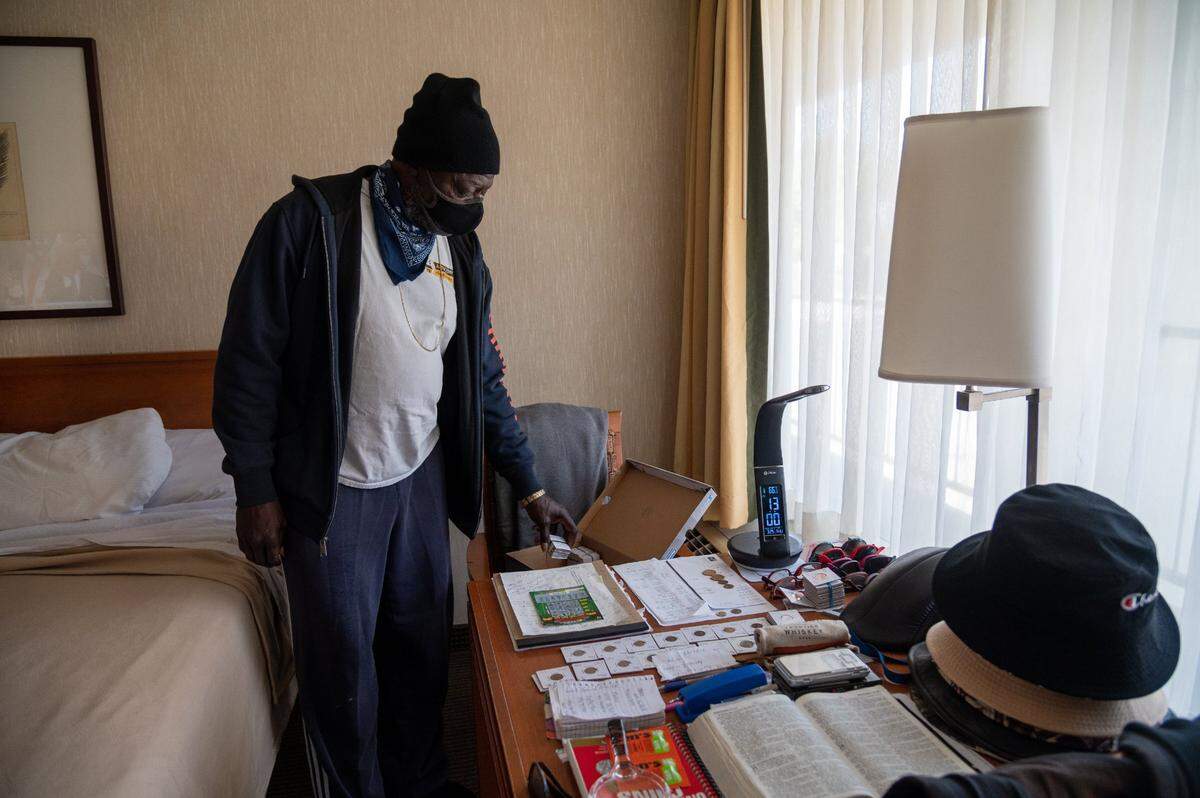
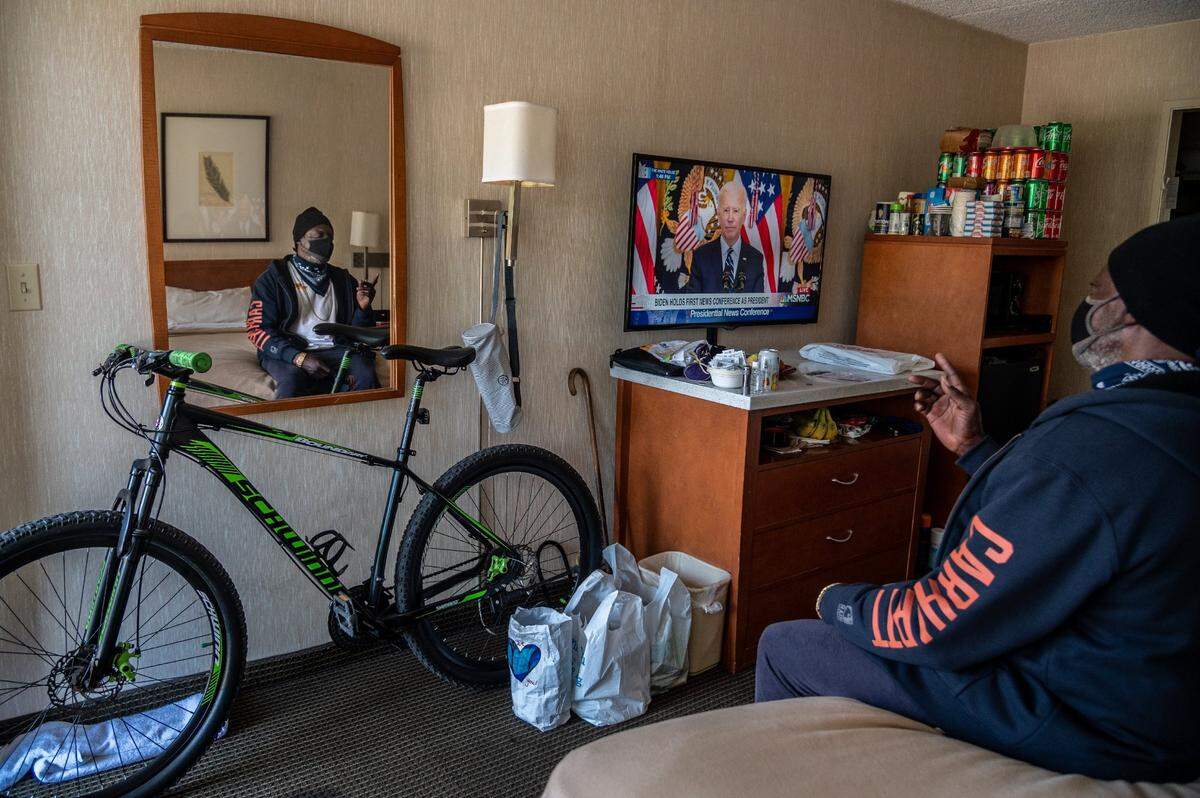
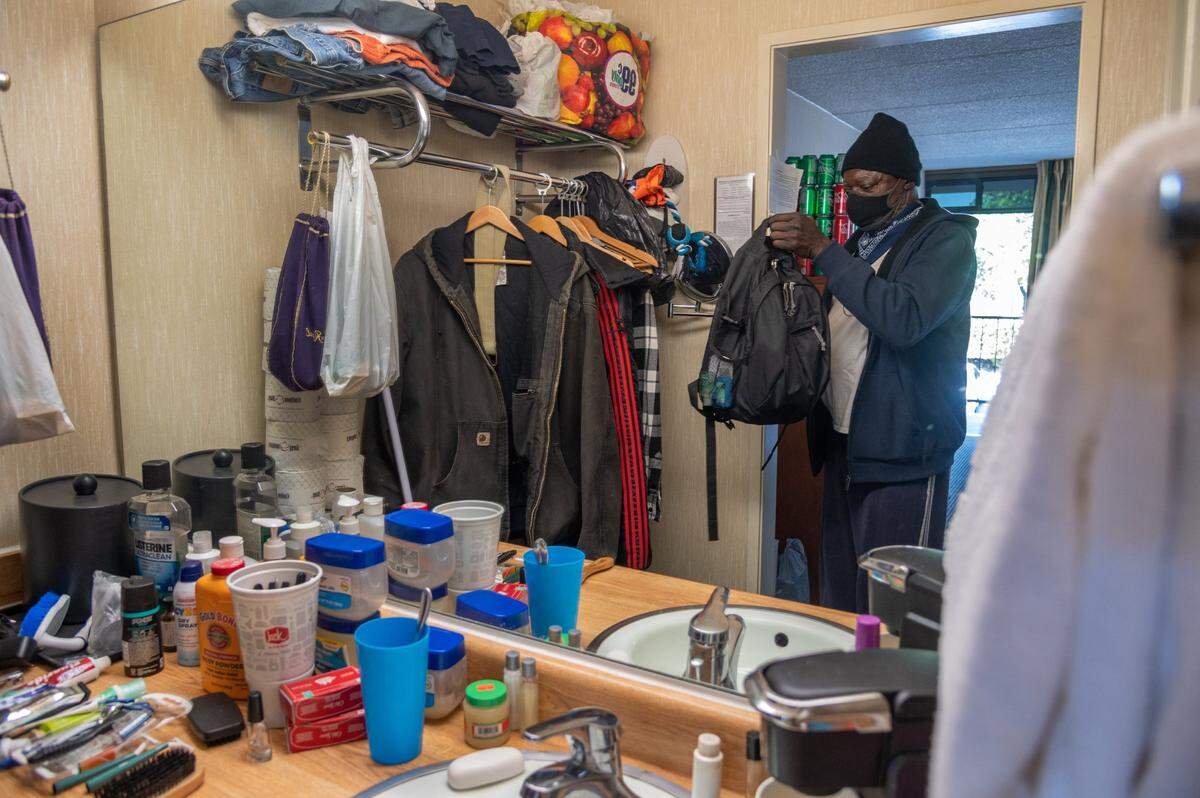
In the nine months since he’s moved in, Rogers has stockpiled his room with personal items, like an inventory of Coca-Cola, toiletries and new clothing. He has a television, with time to watch the news. A medical staff regularly checks his vitals and tests him for the virus. Janitors cleans his room once a week. The program offers vaccinations.
“Totally different, from a tent to a room with running water, TV. Better quality of living,” Rogers said. “I don’t know who started (the program), but God bless them.”
Field, with Sacramento County’s homeless services division, said Project Roomkey offered some participants their first chance in years to reinvest in their health and take care of untended-medical issues.
“At each site we had an RN and two medical assistants. They would do the rounds, check in with folks, test for people coming back in, other medical evaluations,” Field said. “People having that care and regard on site was really beneficial.”
Arturo Baiocchi, an associate professor of social work at California State University in Sacramento, said the fact that Project Roomkey helped save lives represents a success in itself.
“I think putting folks in hotels was a great humanitarian effort and a great idea,” he said. “When you put people in a hotel, you’re reducing the harm of living on the street.”
One of Project Roomkey’s most important goals is assisting residents with finding permanent housing.
In the decade he’s been homeless, Rogers said he’s been inside many times, but never on his own.
Through Project Roomkey, he’s been accepted for a studio apartment on Sunrise Boulevard in Rancho Cordova. He’s planning to move in once renovation on the unit is completed.
“I’m almost there,” he said. “Waiting for that to happen.”
‘It wasn’t for everybody.’
Project Roomkey couldn’t help everyone. Roadside tents remained prevalent in California throughout the pandemic despite the surge in funding.
“It wasn’t for everybody,” Field said. “We had to have rules. I know we’ve made people unhappy with it. As many people we’ve made happy, we’ve made unhappy, because it’s not meeting their personal needs. We’ve tried to personalize this program, but it just doesn’t fit for every person.”
When participants repeatedly violated the rules, Field said, they were asked to leave. Others “self-exited,” she said.
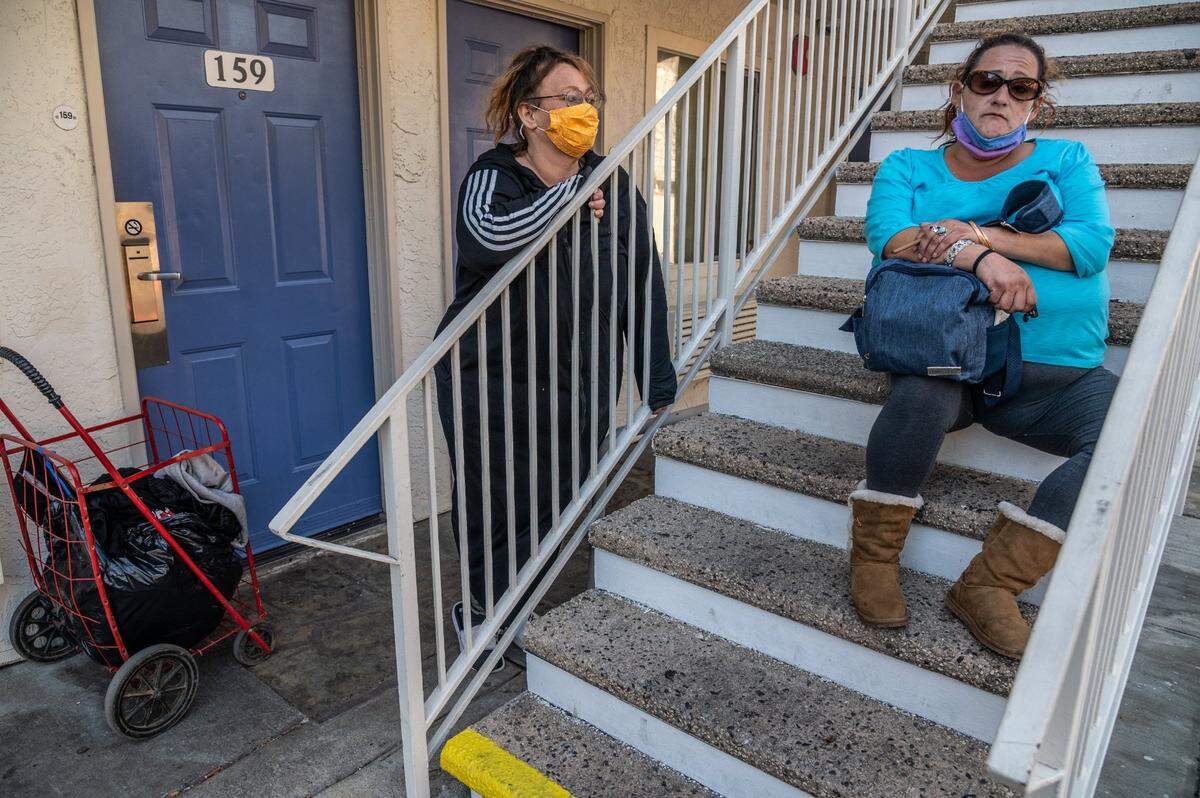
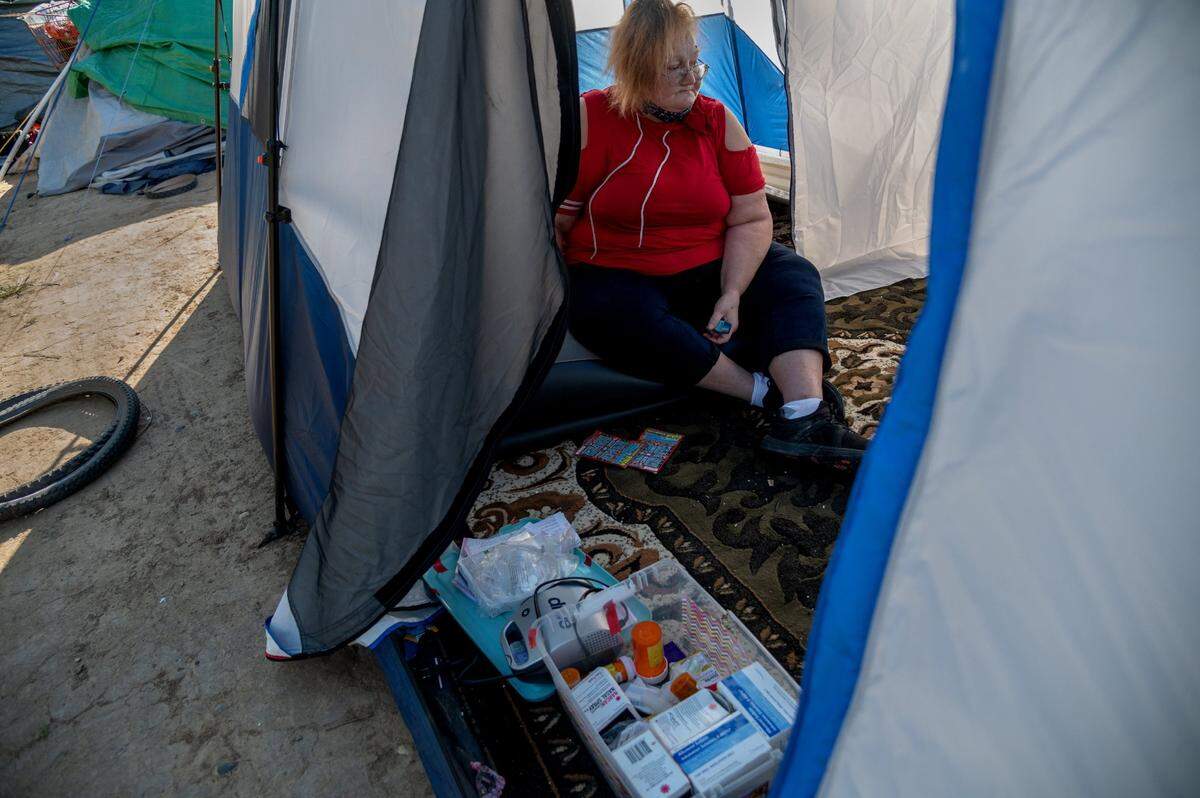
Betty Rios, 48, said she was asked in mid-February to leave the Vagabond Inn after living there through Project Roomkey since June.
She qualified for the program while living in the Morrison Creek encampment off Stockton Boulevard in south Sacramento. Rios said she has asthma and cancer, is diabetic and still recovering from a two-year-old arm injury.
Now she’s living temporarily in a Motel 6, and has already set up her tent back at the creek with plans to return this week. Rios said she wasn’t given a reason why she was told to leave the Vagabond Inn.
“I would’ve stayed (in Project Roomkey),” she said.
Faye Wilson Kennedy, lead organizer for the Sacramento Poor People’s Campaign, said it’s understandable that the program has strict boundaries. She added that it’s still important for program officials to work with participants on solutions.
“It’s good that some people are being housed. But it’s not good that the regulations, policies and procedures are not as accommodating as people would like them to be,” Wilson Kennedy said. “Maybe things like that could be addressed. But that means the programs really have to be willing to listen to the folks that they are engaging and not see them as clients, but see them as collaborators.”
Will more be homeless after COVID?
Homeless advocates and some lawmakers say the challenge now will be using Project Roomkey’s momentum to build other programs to scale.
“It is the right way, the right direction,” Sacramento Mayor Darrell Steinberg said. “The challenge is that the inflow of people who become homeless is more than the number of people we get off, even in record time. What makes me more hopeful in the post-COVID era is knowing what works.”
The economic downturn and lifting of financial safeguards — like a statewide eviction ban scheduled to expire at the end of June — could also spike homelessness numbers, experts say, making it even more critical for California to double down on a new strategy.
Baiocchi of CSU Sacramento said it’s too early to estimate how much of an increase in the unsheltered population California will see in the next few years. That will depend, he said, on how federal financial relief is used, whether there’s support for low-income renters and if the state can dramatically increase its affordable housing supply.
“I think there will be an increase in homelessness,” Baiocchi said. “But the magnitude, the ifs, are hard to tell.”
Still, Newsom during his March 9 State of the State address said he was committed to “bringing the same spirit of innovation” to long-term solutions . In his January budget proposal, he allocated another $750 million in one-time grant funding for Homekey, along with hundreds of millions more for wraparound support services.
“While we acted swiftly during this pandemic, we are mindful that these tent cities on our sidewalks and the encampments along our freeways simply remain unacceptable,” Newsom said. “We’re committing nearly $2 billion this year to create more homeless housing, addressing mental health and substance abuse issues, and ending homelessness one person at a time.”
This story was originally published April 2, 2021 at 5:00 AM with the headline "California took 35,000 homeless people off the street for 1 year. Did the program work?."