
Remains, clothes, weapon? Here’s what Kristin Smart investigators were likely searching for
Forensics and archaeology have moved back to the forefront of the Kristin Smart missing person investigation after the San Luis Obispo County Sheriff’s Office spent nearly two days examining the home and yard of the prime suspect’s father.
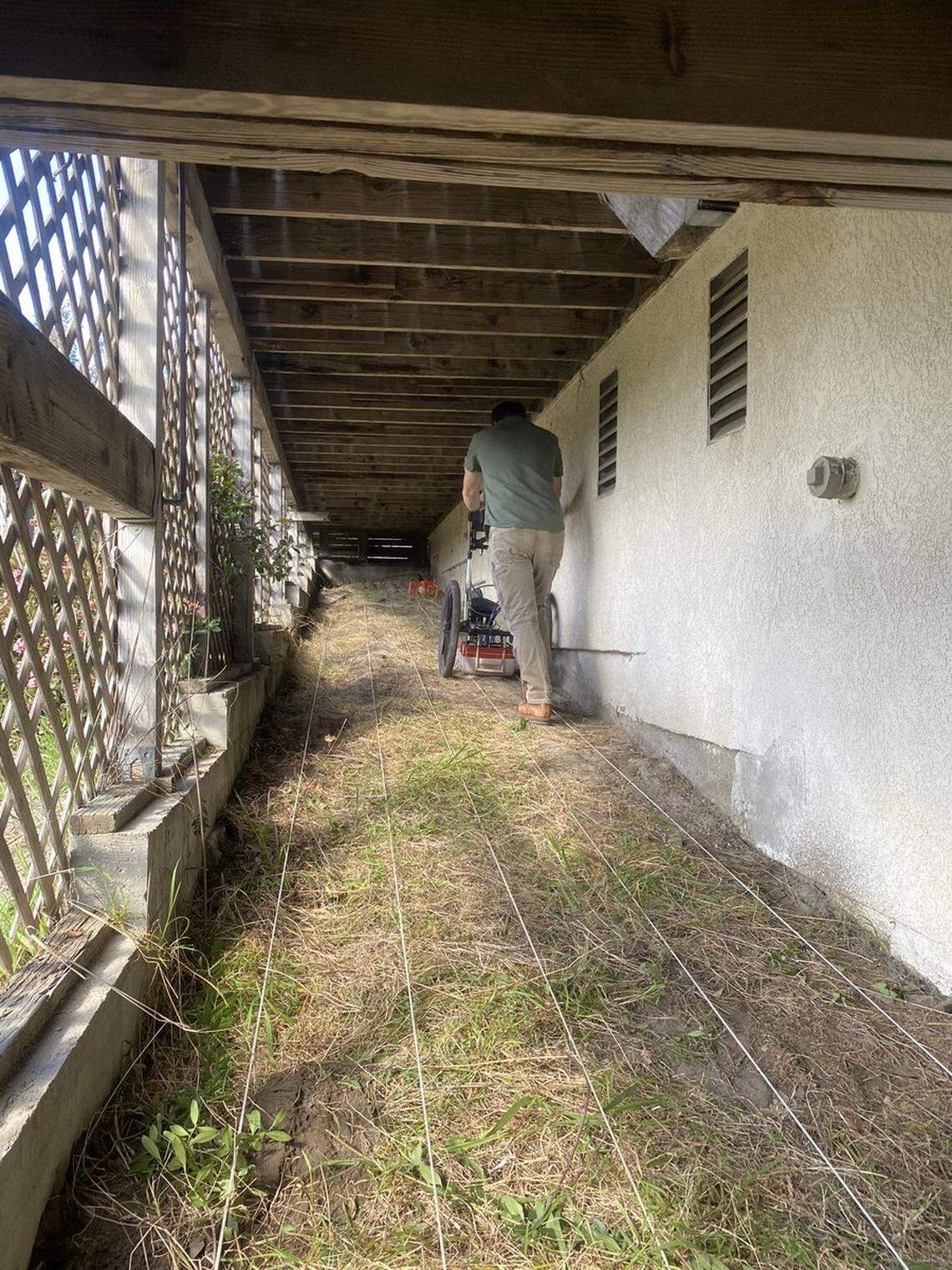
On Monday and Tuesday, Sheriff’s Office officials used ground penetrating radar, cadaver dogs and shovels to search for possible evidence at the Arroyo Grande property owned by Ruben Flores. They also seized a 1985 Volkswagen in connection with the case.
Smart went missing May 25, 1996, while walking back to her Cal Poly dorm room from an off-campus party and was last seen with Ruben Flores’ son, Paul Flores.
While authorities aren’t commenting on what they may have found, national and local experts in forensics, ground-penetrating radar and archaeology spoke with The Tribune about generally what investigators are looking for when they search underground for clues and human remains.
“In forensic searches, ground-penetrating radar is a powerful, non-invasive, and relatively rapid method for investigating subsurface soil conditions,” said Peter Leach, an archaeology and forensics specialist with New Hampshire-based Geophysical Survey Systems “Combined with other forensic methods, like informant information, cadaver dog hits, probing, or other techniques, GPR is an ideal way to refine the search area.”
Possible clues from cadaver dogs
At this point, the only publicly known piece of evidence removed from the property was a red 1985 Volkswagen Cabriolet, which hasn’t been registered for use in more than a decade.
Investigators haven’t said why they confiscated the car, but Chris Lambert, the creator of the eight-part podcast series “Your Own Backyard,” believes it’s because cadaver dogs searching the property reacted to the vehicle.
Lambert told The Tribune he observed the investigation from nearby areas and saw the dogs respond.
One dog barked and another sat in a pronounced way, Lambert said.
Lambert acknowledged he didn’t get an explanation from the handlers about exactly what may have caused the dogs to react, adding he has no information from sheriff’s officials about why they took the vehicle.
“I was not on the (Flores property) site, but I did observe them from a clear vantage point of a neighboring area,” Lambert said.
Cadaver dogs are trained to alert to the scent of human decomposition and pinpoint locations where people have died, with the ability to pick up decomposition scents dating back decades, according to a California forensic expert who agreed to speak with The Tribune off the record.
“I have even worked with dogs that have been alerted to the scent of decomposition at the Donner Pass (where 42 people died in the 1840s in a harsh winter storm in the Sierra Nevada mountain range),” said the expert, adding he’s familiar with the Smart case. “How the dogs alert depends on the handler, and what they’re trained to do, whether it’s to sit or bark or point their nose and hold their position where they identify a scent of decomposition.”
Cadaver dogs typically don’t have the ability to identify a specific person’s corpse, just the scent of human decomposition in general, the expert said. But they can differentiate between humans and animals.
The expert said dogs can alert mistakenly at times when no human decomposition is present (sometimes because they’re tired or frustrated with not finding the scent of a dead body, as they’re trained to do).
But he said that multiple cadaver dogs often are used to avoid the possibility of a false notification. And evidence ultimately must be gathered through digging and other means, such as DNA testing or dental records matching, to confirm the hunch.
For their part, sheriff’s officials have remained tight-lipped on the search.
They issued a news release Monday noting: “The search warrant (at the Flores home) has been sealed. As a result, we are precluded by law from disclosing any further details regarding it. This is an active and ongoing investigation.”
What types of results can a probe yield
The use of ground-penetrating radar suggests investigators are looking for physical remains, materials like clothing, a weapon or areas where the earth has been disturbed.
Ground-penetrating radar can yield results depending on a number of factors and what types of objects or remains investigators are looking for, experts told The Tribune.
That might include the type of clothing, whether it was natural fiber or synthetic and the chemistry of the soil, said Max Houck, a former FBI forensic anthropologist and chemist, now with Florida International University’s National Forensic Science Technology Center, in an email response to questions.
Most synthetic fibers, like nylon or polyester, last a long time; cotton fibers could be preserved as well, depending on the soil conditions and how far down they were buried, Houck said.
“Bones should fare well except in the most acidic soil conditions,” Houck said. “Teeth preserve best, as the enamel covering them is the hardest material our bodies make. Think of all the chewing and grinding over a lifetime.”
The human remains themselves may not appear as a target, but the disturbance of soil materials indicates that possible digging has occurred, said Leach, the archaeology and forensics specialist.
“A ground-penetrating radar operator looks for evidence of subsurface soil disturbance or other anomalous signatures that could indicate locations where a hole has been excavated and filled in,” Leach said.
Houck said that radar searches sometimes identify where graves have been dug.
“If you find the edge of a grave, where the soils were removed and shoveled back in, the soil will be less dense and you’ll get less resistance (the probe goes in easier),” Houck said. “... Excavation is, of course, the ultimate check on any method of clandestine grave detection.”
How well preserved is 25-year-old DNA?
If investigators find human remains, how useful might they be after so many years?
The type of DNA used to identify a person would not be as well preserved in a case that’s nearly 25 years old compared with a more recent burial of evidence, whether that’s human remains or other materials, experts said.
“At this time depth (25 years), the only type of DNA analysis that would be possible is mitochondrial DNA analysis,” Houck said.
Houck said that mitochondrial DNA (mtDNA) is inherited through mothers, and all siblings generally have the same mtDNA. Some mtDNA sequences repeat in non-related individuals.
But while that type of DNA wouldn’t necessarily yield as high of a probability of identifying someone, it’s helpful in excluding possibilities and narrowing the search.

“Because mtDNA is present in much higher quantities than nuclear DNA and doesn’t degrade as quickly as autosomal DNA (no two people except for identical twins have the same autosomal DNA), mtDNA is useful for identifying missing persons or unidentified remains,” according to the National Forensic Science Technology Center’s project website, “A Simplified Guide to Forensic Science.”
Weight-bearing long bones such as the femur or tibia are preferred for forensic genetic testing, “primarily because of their compact/dense nature; the more dense/compact the bone, the better protective barrier there is for the DNA contained within,” said Angie Ambers, an associate professor in forensic science in the Connecticut-based Henry C. Lee College of Criminal Justice and Forensic Sciences, in an email.
“The resultant bone (or tooth) powder is mixed with a series of chemicals to extract the DNA,” Ambers said. “Once the DNA is extracted, tests are performed to confirm the quantity of DNA recovered and then DNA profiling (STR genotyping) ensues.”
Ambers said the length of a DNA match test “depends on the type of DNA testing performed, the existing backlog of cases in the lab, resources, and personnel availability. DNA testing on skeletal remains can take several weeks or even months to complete.”
Ambers said other types of testing and research can help determine paternal lineage, hair and eye color, skin tone and race.
SLO County private investigator offers insights
Local private investigator and former San Luis Obispo County Sheriff’s Deputy Alan Bond said that typically ground radar searches are capable of identifying potential evidence down a few to 100 feet.
In his experience, teeth and bones are often the body parts used to identify someone in a years-old excavation.
Other evidence can be impacted by wetness and soil quality, affecting its composition.
Bond, who also served in law enforcement roles in Orange County, said that evidence can be affected over time, depending on whether animals may tamper with it and the quality of the soil itself, such as how wet it becomes.
“It really depends on the conditions (about how much they can recover),” Bond said. “Artifacts in the Middle East have been recovered that are 2,000 years old.”
Bond, who has taught investigation techniques at Cal Poly and UCSB, said that he believes sheriff’s deputies are digging at the Flores family home for a specific reason.
Bond said he believes the investigators were tipped off in the Smart case to something they were looking for and were likely targeting specific spots on the property.
“Usually law enforcement digs for a specific reason to collect physical evidence,” Bond said. “The key question is, ‘Why now?’”
This story was originally published March 21, 2021 at 5:00 AM with the headline "Remains, clothes, weapon? Here’s what Kristin Smart investigators were likely searching for."
%20Cropped.jpg)