Coronavirus updates: California ‘absolutely’ in a surge, top health official says
With coronavirus numbers spiking rapidly throughout California for weeks, the state’s top health officials sounded further alarm Friday, calling the demotion of several counties into stricter restriction tiers earlier this week an “emergency brake” necessary to get the pandemic back under control.
State Health and Human Services Secretary Dr. Mark Ghaly was unambiguous: He said during a Friday news conference that California’s recent increase in COVID-19 activity is “absolutely” a surge.
Though “surge” is a bit of a nebulous term, Ghaly says there is definitely enough evidence to be worried.
“Certainly cases are on the rise in California, and we are concerned,” he said. “As I say to my patients often, ‘When I’m worried, I’ll tell you so you can worry with me.’ And we’re there.”
Dr. Erica Pan, the state epidemiologist, joined Ghaly in a video conference presentation to share some of the troubling data trends: New cases per 100,000 residents increased during the first week of November at a 20% faster rate than the week of June 15-21, which was the first first full week of the summer surge.
Pan’s percentage refers to the proportional growth within each of those seven-day windows, rather than directly comparing raw case totals from June vs. November. In other words, the state is seeing new cases rise at a quicker pace now than at the start of the summer surge, even when you account for the fact that testing capacity has more than doubled since then.
The number of patients hospitalized with confirmed COVID-19 has increased 35% and intensive care unit patients have spiked 37% in the past two weeks, Pan said. Test positivity is at a flat 4%, up from 3% for the two weeks ending Oct. 29.
Ghaly described California’s reopening framework, which was updated Tuesday to demote nine counties to stricter sets, as the state’s “emergency brake” for when numbers start to climb in any given part of the state.
But he also called upon the public at the individual level to act responsibly and do their part to curb spread. He repeated his plea for people to avoid “high-risk” behaviors — activities outside of one’s immediate household where you can’t keep a mask on, such as eating or drinking, as well as activities where you can’t keep sufficient distance and several other examples.
West Coast states announce travel advisory
In the latest mitigating measure announced amid the worsening nationwide surge, the governors of the three West Coast states on Friday also issued a joint advisory, strongly urging against non-essential out-of-state travel. The advisory asks those who do travel to self-quarantine for 14 days upon arrival in California, Oregon or Washington.
“Increased cases are adding pressure on our hospital systems and threatening the lives of seniors, essential workers and vulnerable Californians,” Gov. Gavin Newsom said in a prepared statement. “Travel increases the risk of spreading COVID-19, and we must all collectively increase our efforts at this time to keep the virus at bay and save lives.”
The three states continue to recommend, on top of avoiding travel, that “individuals limit their interactions to their immediate household,” the announcement from Newsom’s office reads.
“This will be hard, especially with Thanksgiving around the corner,” Oregon Gov. Kate Brown said in the joint statement. “But the best way to keep your family safe is to stay close to home.”
California on brink of 1 million cases, with hospitalizations on rise
Newsom’s office in the morning’s travel advisory announcement said the state has surpassed 1 million cases. The California Department of Public Health after a Friday update lists the official total at 998,502. Over 18,000 residents have died of the virus, the state says.
California will become the second state to reach the million-case milestone. Texas, which has about 10 million fewer residents than California’s 40 million, hit the mark several days ago.
After solid progress trimming down its numbers in September and the first half of October, California’s coronavirus crisis is worsening again, though it’s not yet experiencing the dire levels seen elsewhere in the U.S. such as the Midwest, where hospitals are already being overloaded with COVID-19 patients.
Still, California’s coronavirus infections and the statewide test positivity rate have been rising consistently since mid-October, state data show. In the past two weeks, the state has averaged more than 5,800 new infections per day, and 4% of diagnostic tests for COVID-19 have returned positive. The two-week rolling rate had dipped to a record-low 2.5% in mid-October.
The total for patients hospitalized with the respiratory disease has also spiked sharply since late October, along with the number of them requiring intensive care.
There were 3,399 in hospitals and 931 in ICUs as of a Friday update from CDPH, the most for each figure in about two months.
Mid-June through August remains the state’s worst period yet of the pandemic. Daily infections soared, and hospitalizations skyrocketed from 3,100 in mid-June to nearly 7,200 by late July. In turn, August and September had the two highest death tolls of the health crisis, with close to 7,000 fatalities coming in those two months combined.
California’s average daily death toll has fallen to 40, its lowest point since early April and well below the 140 daily deaths averaged at the peak of the summer surge. But death rate, an indicator that correlates with hospitalization and ICU trends but tends to lag behind them by a few weeks, could likely begin to accelerate again before the end of November.
Demotions take effect in Sacramento, other counties
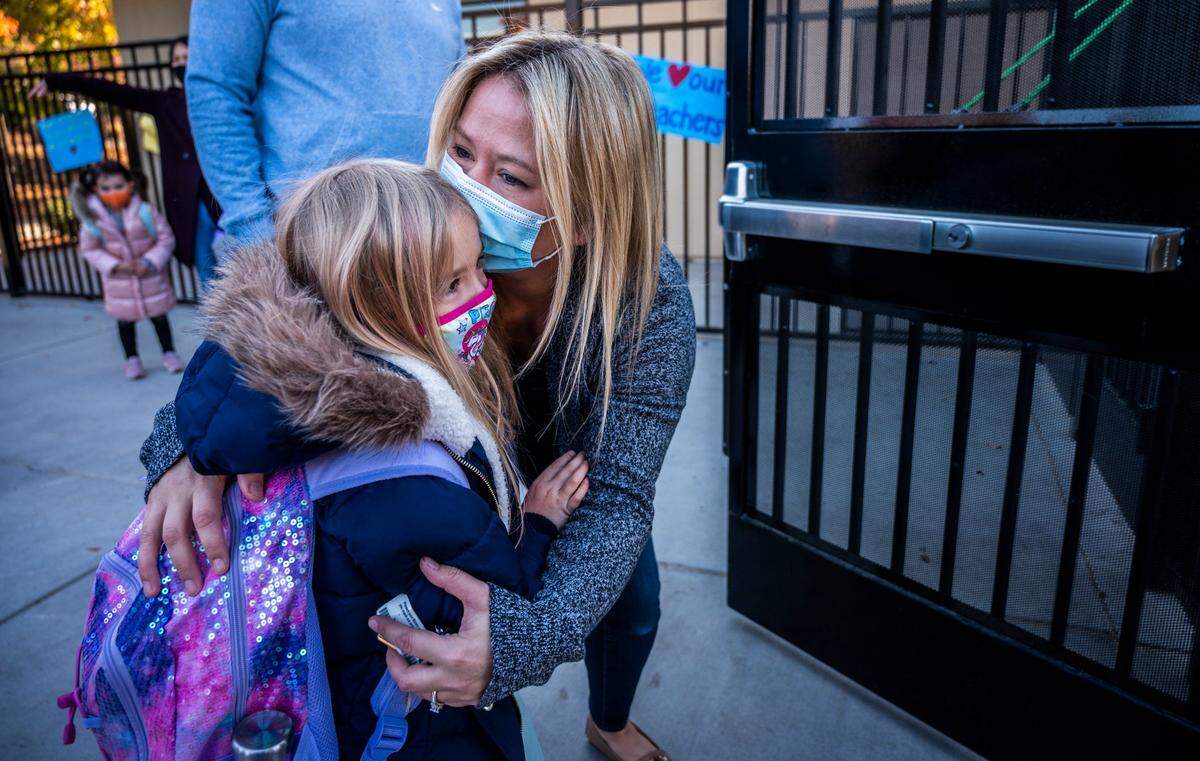
The state demoted Sacramento and San Diego counties on Tuesday to the purple tier, the strictest set of restrictions within the state’s COVID-19 risk assessment system. The downgrade means restaurant dining rooms, gyms, places of worship and a few other businesses and activities must close down indoor operations. School districts not already in the process of opening must pause their campus reopening plans.
Sacramento County’s local health order amendment to close those businesses takes effect at noon Friday, in line with a three-day grace period for compliance allowed by state health officials.
For many Sacramento restaurants, outdoor dining was feasible in spring and summer but has become far less practical as nighttime temperatures dip to the 50s, 40s or colder.
And in another quirk of timing, elementary school campuses in one suburban Sacramento County K-12 school district reopened on Thursday, two days after the purple tier announcement, because their plan to reopen this week was already in place. Nearly 5,000 students returned to 20 Folsom Cordova Unified campuses on Thursday.
Seven other counties were demoted to the middle red or orange tiers this week. Those counties — Amador, Contra Costa, Modoc, Placer, Santa Cruz, Siskiyou and Trinity — have through the end of Friday to implement reductions to indoor capacity limits, cutting many of them in half compared to their previous yellow or orange tier requirements. They must also close a shorter list of mostly entertainment-based venues, such as bowling alleys and climbing gyms.
San Francisco is still in the yellow tier, but is banning indoor restaurant dining effective 11:59 p.m. Friday, proactively and well ahead of state health officials requiring the city to do so. Mayor London Breed announced the restaurant closure order earlier this week.
No counties were promoted this week; none even gained a week of credit toward a looser tier.
Twenty others spread across the state face potential demotion in next week’s updated list if their two main COVID-19 metrics — new cases per 100,000 residents and test positivity — do not improve enough to meet their current tier levels’ requirements.
Next Tuesday’s update will use data from the survey week of Nov. 1 to Nov. 7 to make tier assignments.
Sacramento region by the numbers: Over 670 dead
The six-county Sacramento region has combined for at least 673 COVID-19 deaths during the pandemic and is approaching 44,000 total confirmed cases.
Sacramento County has recorded a total of 29,837 cases and 520 deaths. The county reported a record-high 496 new cases on Thursday, followed by 327 on Friday.
There were 177 patients hospitalized with coronavirus in Sacramento County as of Friday, an increase of 24 from Thursday. The figure peaked at 281 on July 30. It hasn’t been as high as 200 since Aug. 29.
The county’s ICU total has doubled in the past week, from 20 on Nov. 6 to 41 on Friday.
The county has updated October’s death toll to 54, and four have now died in the first week of November.
Yolo County has reported 3,649 total infections and 64 deaths from COVID-19. The county reported 38 new cases Thursday, following 34 on Wednesday and 51 on Tuesday. Health officials reported one new death Tuesday in an unincorporated part of the county.
Yolo had nine patients in hospitals with COVID-19 as of Friday, up from five on Thursday, with three still in ICUs, state data show.
Yolo County entered the week at risk of demotion, but remained in the red tier after numbers improved compared to the previous week. The earliest Yolo could move to a stricter or looser tier is Nov. 24.
Placer County surpassed 5,000 cases on Thursday. The county reported 78 cases and one new death Friday, following 63 new cases and two new fatalities Thursday, bringing the totals to 5,134 infected and 63 dead.
Placer reported on its local hospitalization dashboard Friday that it had 43 patients in hospital beds with COVID-19, all but one of them being treated specifically for the disease, and four in ICUs for COVID-19 treatment. State data updated the same day showed 46 hospitalized in Placer County and six in ICUs.
Placer on its dashboard says its test positivity rate was 4.8% for the week ending Nov. 4, the most recent span with data available. The rolling seven-day average has shot up 0.7% in two days and is now at its highest point in more than two months.
Because Placer’s move from the orange tier to the red tier on Tuesday was delayed by one week due to the county’s adjudication request, which was denied, and because its rate of new cases per 100,000 fell in the purple tier, Placer County faces demotion down to the purple tier as early as next week. It is unclear whether it can or will adjudicate again, if that downgrade happens.
El Dorado County is one of a few California counties with a single-digit death toll, with just four fatalities since the start of the pandemic. Health officials have reported a tally of 1,600 cases after adding 42 cases Thursday in a two-day update, following no update Wednesday due to Veterans Day. The county added 21 new cases Tuesday afternoon.
El Dorado has four hospitalized COVID-19 patients as of Friday, all of them in ICUs, down one from Thursday.
El Dorado County has entered an adjudication process with the state to remain in the orange tier despite failing to maintain the metrics required of that stage for the past two weeks.
Sutter County health officials have reported a total of 2,134 people positive for coronavirus and 12 deaths. The county reported 25 new cases Thursday. Five people infected with COVID-19 were hospitalized as of Thursday, and one person was in intensive care, according to county health officials.
Yuba County officials have reported a total of 1,529 COVID-19 infections and 10 deaths. The county reported 26 new infections Thursday. Yuba had two patients infected with COVID-19 hospitalized, with one in an ICU.
Sutter and Yuba, which share a bi-county health office, are both in the red tier but both failed to meet red-tier requirements in Tuesday’s update from the state. They face demotion to the purple tier as early as next week.
World numbers: Global death toll nears 1.3 million
Coronavirus activity in the U.S. continues to lead the world. The nation now has reported more than 10.5 million lab-confirmed cases and nearly 243,000 coronavirus deaths, according to data compiled by Johns Hopkins University.
The global totals are 53 million infected and just shy of 1.3 million dead.
The U.S. added more than 153,000 new cases Thursday, a new record, according to Johns Hopkins. On Wednesday, the global case total increased by 666,000, also a single-day record.
Following the U.S. in death toll are Brazil at 164,000, India at 129,000, Mexico at 97,000, the United Kingdom at 51,000, Italy at 44,000, France at about 42,500, and Iran and Spain each at about 40,500. Next are Peru and Argentina at close to 35,000 dead, and nearly 33,500 fatalities in Colombia. More than 32,000 have died in Russia.
In terms of infections, India follows the U.S. with more than 8.7 million, and Brazil is next at almost 5.8 million. France is closing in on 2 million, while Russia has surpassed 1.8 million. Spain, the United Kingdom, Argentina, Colombia and Italy all have between 1 million and 1.5 million cases, and Mexico is closing in on the million-case mark as well.
This story was originally published November 13, 2020 at 9:45 AM with the headline "Coronavirus updates: California ‘absolutely’ in a surge, top health official says."