Coronavirus updates: 19 dead, 1,000 infected in California; what stay-home order means
Stay at home.
That legal order from California Gov. Gavin Newsom on Thursday instructed the state’s 40 million residents to only go out for essential reasons and to maintain social distance from others when doing so, the latest and most-sweeping action taken in an urgent effort to slow the spread of the coronavirus pandemic.
Newsom’s order came as more than a dozen counties including Sacramento and most of the Bay Area, making up close to 10 million Californians, had already instituted legal stay-at-home or “shelter-in-place” mandates within county jurisdictions. Sacramento County leaders did so Thursday morning.
The unprecedented measures are an attempt to “flatten” the pandemic curve and keep infection rates to a level that health systems can handle. Newsom, during a Thursday news conference announcing the order, said the state is projected to be short by about 19,500 hospital beds needed to treat a surge in patients due to COVID-19.
In a Wednesday letter to President Donald Trump, Newsom also said his office projected 56 percent of California’s population, an astounding 25.5 million people, would be infected with the coronavirus over the next eight weeks. The governor on Thursday clarified that this projection was based on a scenario in which the state took no action to mitigate spread of the disease.
The coronavirus as of 11:30 a.m. Friday had infected over 265,000 people worldwide and killed more than 10,000, according to data by Johns Hopkins University, and the number of cases has skyrocketed above 16,000 in the United States, compared to about 10,000 the previous morning. The Johns Hopkins map shows close to 200 coronavirus deaths in the U.S., and California’s public health department says 19 have died in the state.
California’s latest COVID-19 numbers: Over 1,000 cases
The state Department of Public Health reports that as of 6 p.m. Thursday, there have been 1,006 confirmed reports of the coronavirus and 19 deaths in California, an increase of more than 330 cases and three fatalities since 24 hours earlier.
The state’s total, with numbers publicly updated shortly after 11 a.m. includes 24 patients related to repatriation flights, but does not include passengers from the Grand Princess cruise ship that recently docked and offloaded in Oakland.
Of the 651 cases not related to repatriation, a total of 522 cases are under investigation, 266 were community acquired, 108 came from person-to-person contact involving a known case and 86 are considered travel-related, according to the state health department.
What does Newsom’s stay-at-home order mean for Californians?
The statewide stay-at-home order, which went into effect Thursday evening and is in place until further notice, still allows essential services to remain open, including grocery stores, convenience stores, takeout and delivery restaurants, pharmacies, gas stations, banks and laundry services, the state’s newly established COVID-19 website explains.
Also still in service are those “needed to maintain continuity of operation of the federal critical infrastructure sectors, critical government services, schools, childcare, and construction, including housing construction,” the state website explains, though virtually all of the state’s public school districts have shut down in the past week, and Newsom earlier this week suggested they may not reopen until after summer break.
The U.S. Department of Homeland Security identifies 16 “critical infrastructure sectors” that must remain active during the COVID-19 crisis, which include communications, energy, dams, emergency services, water and wastewater, transportation, food and agriculture, financial services and health care. California workers in those industries will continue to work or telecommute, the executive order stipulates.
On the other end, all eat-in restaurants, bars, nightclubs, gyms, barbershops, nonessential retail stores, movie theaters and other entertainment venues must close, the order says, and public gatherings of any size must be canceled or postponed.
You can still go outside for things like exercise or to walk your dog, but the order requires maintaining a safe social distance of 6 feet from others when doing so, Newsom said.
Newsom said he hopes not to have to enforce the order, instead encouraging Californians to influence one another to do the right thing.
“I don’t believe the people of California need to be told through law enforcement to home isolate, protect themselves,” he said.
Cases reported at California prisons
One employee at California State Prison, Sacramento in Folsom and another at San Quentin have tested positive for coronavirus, the state Department of Corrections and Rehabilitation said Friday.
So far no inmates have tested positive for the virus, according to CDCR.
A corrections department source said Thursday that four inmates at Mule Creek State Prison near Ione have been quarantined because they developed coronavirus-like symptoms, but that the inmates were still being allowed to use the yard by themselves every 72 hours and that they were being housed near other inmates.
Sacramento facing ‘ridiculous’ lack of tests, health director says
Sacramento County public health chief Peter Beilenson told The Sacramento Bee on Thursday that the actual number of people infected with the virus could be anywhere from 20 to 100 times higher than what’s been reported.
So far, what’s been reported as of Friday by Beilenson’s department is 53 confirmed coronavirus infections and three deaths as of Friday afternoon in the county, which has a population of about 1.5 million people. The county had reported 45 cases as of a day earlier.
But Beilenson called the federal government “woefully inadequate” in its delivery of test materials like swabs and reagent, forcing public health officials and healthcare providers to ration tests to the most vulnerable cases nationwide, including in Sacramento.
The good news is that drive-through public testing for thousands of residents could be available at several sites in the county late next week, Beilenson said, though he declined to say where they would be set up.
The county public health director nonetheless delivered a scathing indictment of the federal response.
“I don’t know how (the federal government) can’t have prepared for this,” Beilenson said. “You knew that swabs were necessary for this virus in January, you’d think they could produce in a couple months enough swabs.
“It’s ridiculous.”
Sacramento plans cabins, trailers for homeless
California lawmakers earlier this week approved more than $1 billion in emergency spending to respond to the coronavirus. Newsom announced that $150 million would be committed to protecting the state’s homeless population.
Sacramento Mayor Darrell Steinberg told The Sacramento Bee on Thursday that providing shelter for at-risk homeless, who are considered as very vulnerable to the spreading pandemic, is his “priority 1A.”
Steinberg said Sacramento County is expecting to receive at least 50 emergency trailers from the state, and trailers and cabin-style shelters that have already been under construction locally will be placed at sites near the W/X freeway underpass, Meadowview and in north Sacramento. The city has also set aside $250,000 for sanitizing and other homeless services, which is being combined with county funds, Steinberg said.
Newsom is deploying more than 1,300 emergency trailers across the state and identifying more than 950 motels and hotels that can be converted into shelters, the governor said Wednesday.
Animal shelters close to public, seek foster owners for dogs
The two main animal shelters in the Sacramento area are each suspending most of their operations, including public visits and adoptions, due to the coronavirus crisis.
That has left the city-run Front Street and the county-run Bradshaw Road shelters scrambling to find foster owners for their pets.
Front Street shelter manager Phillip Zimmerman said the closures meant finding new homes for 83 dogs and 10 cats. Zimmerman said Thursday that the cats have already been accounted for, and that he believes the dogs will find new homes by Friday.
The shelter will remain open with a small crew to care for animals that are sick, aggressive or can’t be moved for some other reason, Zimmerman said.
Bradshaw Road officials pleaded with residents not to bring in strays, but director Dave Dickinson said the facility will have enough staff on hand to feed and clean the animals that are already there.
Similar calls have been made to the public by animal shelters throughout the state.
‘Please do not panic buy’: Grocery stores still face supply issues
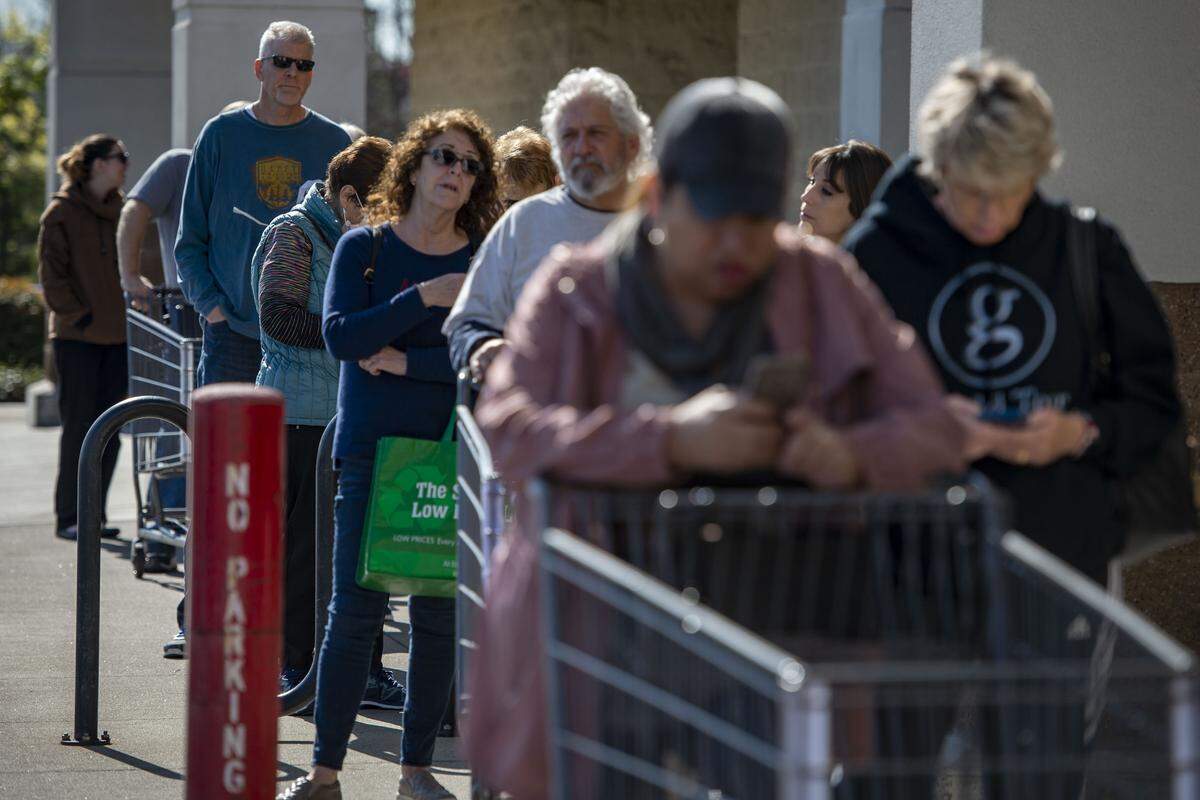
Northern California supermarket chains have asked customers not to panic buy or hoard essential supplies, as surges of shoppers have left shelves in the hand sanitizer, soap, paper towels and toilet paper empty within hours of opening.
“If we all normalize our buying behavior and resist the unnecessary need to stockpile, everyone can have what they need,” Raley’s CEO Keith Knopf said in a recent statement posted to the grocery company’s website.
Raley’s has instituted limit of two-per-family on some items, including milk, eggs, water, fresh-packaged chicken and paper products. It has also started a program for customers 65 and older, providing a pre-prepared bag of grocery staples at discounted prices.
Raley’s stores have recently had law enforcement, including Sacramento County Sheriff’s deputies, stationed outside of stores.
Sheriff’s spokeswoman Sgt. Tess Deterding said the move was initiated by Raley’s to increase security, not the sheriff increasing patrols. Company spokeswoman Chelsea Minor did not say how many stores will be using the deputies, but said the move is a precaution.
“This is a preventative measure,” she said in an email. “For customer and team members peace of mind, we have increased security in our stores.”
Woodland-based Nugget Markets on Thursday announced it will designate temporary shopping hours twice a week for elderly customers, beginning next week. These hours will begin next week on Tuesdays and Thursdays from 6 to 8 a.m. or from 7 to 8 a.m. depending on the Nugget Markets store locations.
Nugget Markets opening at 6 a.m. are in Davis on Covell Boulevard, El Dorado Hills, Elk Grove, Roseville, Sacramento, Vacaville, West Sacramento and Woodland; Sonoma Market, Fork Lift by Nugget Markets in Cameron Park and Food 4 Less in Woodland.
Nugget Markets opening at 7 a.m. are in Davis on Mace Boulevard, Corte Madera, Novato and Tiburon.
“Please do not panic buy; we all need to work together and we will get through this,” President and CEO of Nugget Markets Eric Stille said in a written statement.
Latest numbers: Coronavirus infection totals growing fast worldwide
By 11:30 a.m. Pacific Time Friday, there were just over 265,000 confirmed case of the coronavirus, a data map maintained by Johns Hopkins University shows, a growth of neary 30,000 in the past 24 hours.
The United States now has more than 16,000 confirmed infections, one of seven nations with five-digit totals. China, where reported growth rates have stalled considerably, stands at about 81,000 cases. Italy, the new epicenter of coronavirus activity, has 47,000 cases and has surpassed 4,000 deaths.
Next on the list are Spain at about 20,000 infections and 1,000 deaths; Germany at 19,700 cases and 53 reported deaths; Iran at 19,600 infections and more than 1,480 deaths; and France at nearly 11,000 cases and 371 fatalities.
Infection and death totals have grown rapidly in New York state, which now has more than 7,000 confirmed cases and 38 deaths, according to Johns Hopkins. Washington state has 74 reported deaths, California has 19, Georgia has 11, Louisiana has 10 and Florida and New Jersey each have nine, according to the map.
Reminder: What is COVID-19? How is it spread?
Coronavirus is spread through contact between people within six feet of each other, especially through coughing and sneezing that expels respiratory droplets that land in the mouths or noses of people nearby. The CDC says it’s possible to catch the disease COVID-19 by touching something that has the virus on it, and then touching your own face, “but this is not thought to be the main way the virus spreads.”
Symptoms of the virus that causes COVID-19 include fever, cough and shortness of breath, which may occur two days to two weeks after exposure. Most develop only mild symptoms, but some people develop more severe symptoms, including pneumonia, which can be fatal. The disease is especially dangerous to the elderly and others with weaker immune systems.
This story was originally published March 20, 2020 at 8:04 AM with the headline "Coronavirus updates: 19 dead, 1,000 infected in California; what stay-home order means."