New travel restrictions, fear in Washington state over coronavirus. What happened Saturday
After Washington state health officials announced Saturday the first death in the nation from the novel coronavirus, President Trump spelled out new edicts on travel and stressed that the United States is “prepared for any circumstance” as it relates to the disease.
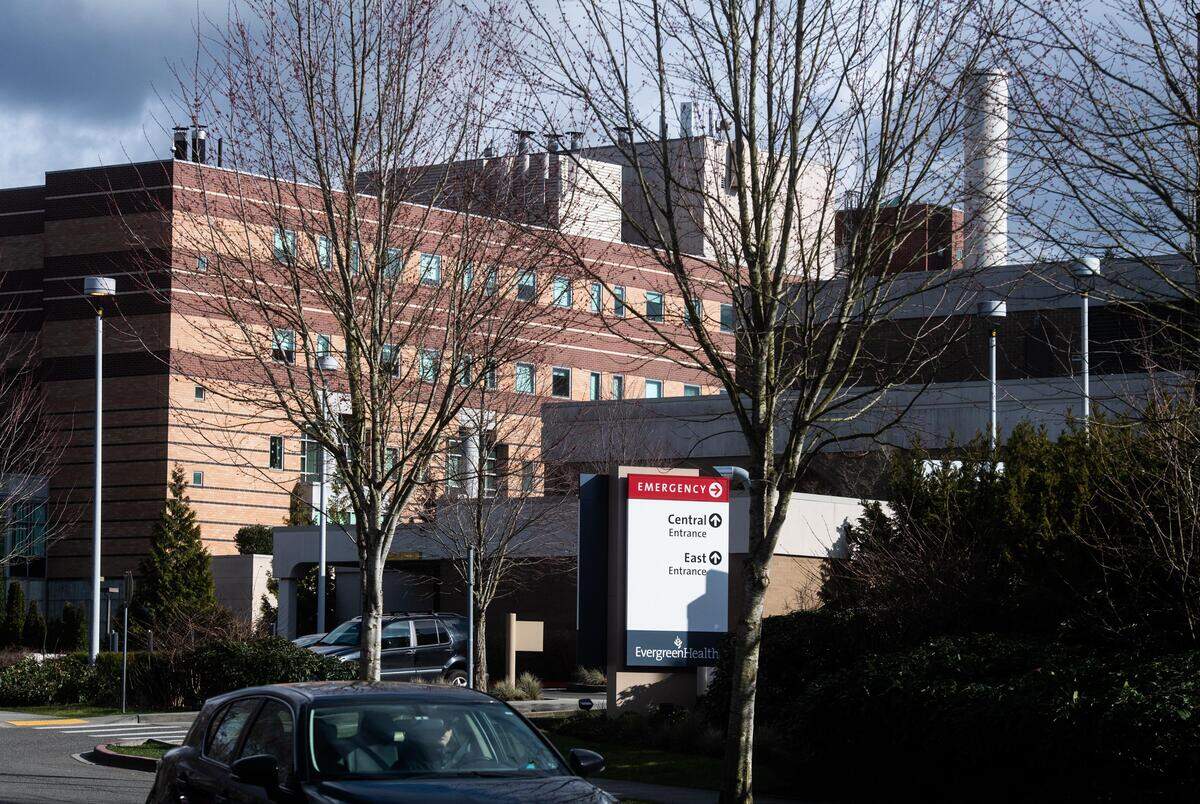
The victim was a man in his late 50s from a medically high-risk population who lived in King County. A spokeswoman for EvergreenHealth Medical Center said the man died overnight in the facility in the Seattle suburb of Kirkland, but gave no other details.
At the news conference in the nation’s capital, Trump said: “Tremendous amounts of supplies are already on hand. We have 43 million masks, which is far more than anyone would have assumed we could have had so quickly, and a lot more are coming.”
Later, he added: “Our country is prepared for any circumstance. We hope it’s not going to be a major circumstance, (that) it will be a smaller circumstance, but whatever the circumstance is, we’re prepared,” Trump said Saturday at a news conference.
Also at the news conference, Dr. Anthony Fauci of the National Institute of Allergy and Infectious Diseases emphasized that the country as a whole remains at low risk but added that this is a situation that “is going to evolve by the day and by the week.” He said federal health officials would keep Americans appraised on a real-time basis.
The NIAID director said public health officials must address this challenging, highly transmissible disease by taking action in both the domestic and global arena. He said it was important to keep U.S. citizens from going to places where the infection is actively spreading and prevent people from places where there are active infections from coming to the United States.
“When you have cases throughout the world where we’re seeing (it) now -- South Korea, Italy, Iran and places like that, the United States cannot be completely immune to that,” Fauci said.”The challenge is how we deal with it, and I can assure that all the resources that are necessary are going to be put into dealing with what we see evolving right now.”
Domestically, Fauci said, local public health agencies will be aggressively identifying, isolating and tracing contacts of people who test positive for the new coronavirus. Public health investigators use contact tracing daily to contain the spread of debilitating and potentially deadly communicable diseases throughout communities.
Fauci said that, going forward, Americans should not be surprised to hear about additional cases because this is something that is anticipated when you get community spread.
In interviews with The Bee, epidemiologists have told The Bee that it’s entirely possible that coronavirus already was being spread in the United States prior to travel restrictions that Trump imposed on Jan. 31.
Epidemiologist Catherine Troisi of the University of Texas Health Science Center at Houston said researchers who have studied the genealogical evolution of COVID-19 have found that it likely was infecting China’s population by early to mid-November. Because thousands of people travel to foreign destinations from the Wuhan airport daily, it’s “absolutely possible” that the virus got here before airport screenings and travel restrictions.
U.S. imposes new travel restrictions
Fauci and other leaders said that, if travel had not been prevented to and from China, “we would have had many, many more cases right here that we would have to be dealing with.”
There have been news reports out of Washington that the president had forced Fauci to cancel interviews with the news media at a time when Americans need more information, but the eminent researcher said he had canceled those interviews because he wanted to confer with the coronavirus task force being led by Vice President Mike Pence. Once he had done that, he said, he began to schedule interviews again.
At the news conference, Pence said the president had authorized banning U.S. entry to any foreign national who has visited Iran within the last 14 days. There have been roughly 600 coronavirus cases there, and it is growing.
Still, South Korea and Italy also have seen a surge in cases. Yet, Pence did not announce bans on entry to people who traveled to those countries. Rather, he said, the Trump Administration would be issuing the highest-level travel advisory, Level 4, to discourage Americans from going to certain regions of those countries.
In a campaign stump speech Friday, Trump labeled coronavirus as the Democrats’ “new hoax,” and when asked about that at the news briefing, he said that he had not meant that coronavirus was a hoax but that Democrats were using it as as political ammunition to undercut him.
Trump also said he was confident in Pence’s ability to lead efforts to confront this public health challenge despite criticism of how Pence handled an outbreak of HIV in Indiana when he was governor there. In his own defense, Pence said that, although Indiana had a ban on needle exchange programs, he declared a public health emergency upon advice from the U.S. Centers for Disease Control and prevention and made a needle exchange available for 30 days.
“I’m proud to say that every one of those patients was treated,” Pence said. “We ended the spread of the HIV/AIDS virus in that community.”
Testing has been limited for COVID-19
The incidence of COVID-19 in the U.S. population is not clear. Until a coronavirus case of unknown origin surfaced Wednesday in Sacramento, Calif., the CDC was testing only people who traveled to China and their close contacts and only if they showed symptoms.
The agency changed the criteria Thursday, allowing testing of people who have a no known source of exposure to be tested if they are hospitalized with a severe acute lower respiratory illness such as pneumonia.
In Washington state, however, public health leaders recently instituted testing in their state lab, and not only can they run more tests but they also can get results back faster - often the same day. Because of updated CDC guidelines, Dr. Francis Riedo of EvergreenHealth said he was able to quickly test two patients at the state lab based on evaluation of their symptoms alone. The patients had no known epidemiological link to travel, but their tests came back positive.
COVID-19, which causes coughing, fever and shortness of breath, grabbed attention in December 2019 when there was an outbreak at a public market in Wuhan, China. The illness has been slowly spreading around the globe, with roughly 86,500 cases and 2,900 deaths confirmed as of Saturday afternoon. The CDC reported 69 U.S. cases on Saturday, including seven presumptive positive results.
Public health officials in Washington state said Saturday that, with the help of the CDC, they are investigating what could be an outbreak of coronavirus at a long-term care facility called Life Care Center of Kirkland. Dr. Jeff Duchin, the health officer for King County, said state testing has revealed two cases of coronavirus there, one a health care worker in her 40s and the other a resident in her 70s. Both have been hospitalized. About 50 other individuals associated with the facility have reported being ill.
“We are now in the process of providing support to that facility to care for the infected patients, to protect the uninfected patients and to provide infection control guidance for their staff,” Duchin said.
Washington state health officials had earlier reported two other cases of COVID-19, including a high school student living in Everett. The origin of the teen’s infection is unknown. The other case was a woman in her 50s who had traveled to a region of South Korea where there is an outbreak. Both are currently in isolation.
Washington state declares emergency
The Washington state man is the second U.S. citizen to die from a new coronavirus infection. Earlier this month, a 60-year-old U.S. citizen died in Wuhan, China. State officials said the man had not traveled abroad.
At Saturday’s news conference in Washington, D.C., Pence sent his condolences to Washington state man’s loved ones, adding: “I want to assure this family that they are in the hearts of every American.”
In prepared remarks released Saturday, Washington Gov. Jay Inslee said: “It is a sad day in our state as we learn that a Washingtonian has died from COVID-19. Our hearts go out to his family and friends. We will continue to work toward a day where no one dies from this virus.”
Two hours later, he declared a state of emergency, saying that residents “can be assured we’ve taken this threat seriously and have been working in collaboration with our health care partners to develop plans and procedures to prepare for what could likely be a worldwide pandemic.”
Duchin, Fauci and other public health leaders stressed that 80 percent of people who get new coronavirus exhibit no symptoms or mild symptoms, and patients frequently do not need to seek professional care. Experts in China have reported, however, that the disease can be transmitted even if a person shows no symptoms.
If you think you are sick, public health experts said, stay home. Since the disease spreads from droplets, Duchin advised “more hand-washing and less face-touching” and leaving more space between people to avoid exposure to coughs or sneezes. He also advised employers to make plans for telecommuting and warned that public health officials may advise canceling large gatherings.
This story was originally published February 29, 2020 at 5:22 PM with the headline "New travel restrictions, fear in Washington state over coronavirus. What happened Saturday."