Fresno’s airport just set an all-time passenger record. Here’s why some aren’t happy
Travelers through Fresno Yosemite International Airport smashed an all-time record in July, the first time in which more than 100,000 passengers flew aboard departing domestic airline flights in a single month.
The airport handled 102,581 departing passengers on domestic flights in July, plus an additional 13,917 on international flights to Mexico, for total passenger traffic of almost 116,500 for the month. That beats the old mark, set in June, of more than 95,000 domestic passengers, and more than 107,000 passengers total. Similar numbers of passengers arrived in July on incoming flights.
Airport officials say the addition of a new airline to Fresno – Southwest Airlines, which launched its daily service to Denver and Las Vegas in late April – is a major factor in the higher numbers this summer.
The unprecedented level of demand for air travel through Fresno’s airport, even in the midst of the global coronavirus pandemic, has created a situation in which passengers who need to find a parking space before their trip are having to look a little farther afield than the long-established main parking lot across from the main terminal building.
Some are steaming over the construction of a new $29 million, four-level parking structure taking up what used to be prime real estate for short-term parking in the lot. But when it’s completed, expected in late October and in time for the busy holiday travel season, the structure will provide a net increase of 700 parking spaces compared with what existed before construction began a year ago.
In the meantime, however, the record levels of travel mean that what’s left of the parking in the main lot can be hard to come by on some of the busiest days, and not everyone knows about additional options that were made available on other parts of the airport property to prepare for the disruption created by the construction.
“We always knew, even pre-pandemic, that parking was one of the pinch points we had to address,” said Kevin Meikle, airports director for the city of Fresno. When construction of the parking structure began a year ago, between summer and winter surges in new COVID-19 cases in Fresno, statewide and across the country, “I think it’s fair to say that nobody expected the type of recovery, and now growth again, this quickly,” Meikle added.
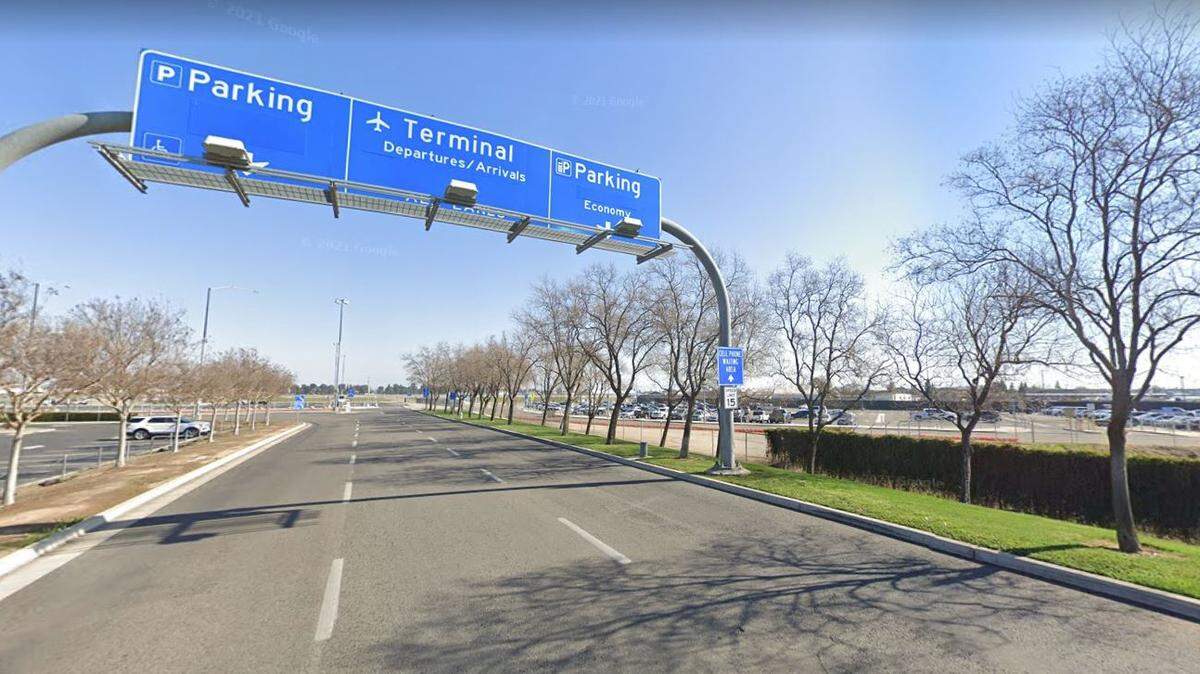
The contingency areas set up prior to construction call for a little more walking to get from the lots to the terminal. One, the former cell-phone waiting area about 800 feet southeast of the terminal entrance, was enlarged and converted into a credit-card-only lot for extra parking.
An entirely new credit-card-only “economy lot” was built south of the main entry drive to the terminal complex, about 1,200 feet from the building. The cell-phone waiting area, where drivers await calls from arriving passengers to pull up to the terminal for pickup, was relocated to the south end of the new economy lot, about 1,600 feet from the terminal entrance, and it, too, has been opened up for long-term parking at no charge.
“We had about an eight-acre chunk of land that we converted to economy parking, employee parking and cell-phone waiting,” Meikle said. “Those were done in late 2018 or early 2019 as an enabling project before we even started work on the garage. … We wanted to maximize the surface lots available for parking.”
The airport also added 16 blue-painted stalls reserved for drivers with disabled-person placards or license plates. Prior to construction, there were 43 stalls.
Between the main parking lot, the additional parking lots and the new parking structure, the airport will have nearly 3,600 parking stalls available to the public, as well as almost 360 stalls for employees at the airport, Meikle said.
Construction of the parking garage wasn’t a major factor inconveniencing drivers until a few months ago, as travel demand rebounded from the pandemic doldrums much faster than expected.
Last winter, during what is usually a busy holiday travel season from Thanksgiving through Christmas and the New Year, “we were OK, because of COVID,” Meikle said. “But by the end of April, we started coming out of this thing, and we were at 75% of our pre-pandemic (passenger) numbers in April.”
By May, “it was 107%, and overnight we crossed this line between ‘recovery’ and ‘growth,’” Meikle added. “It really got tight.”
“We understand that if someone has to circle the parking lot and can’t find a stall, their stress level goes up because they start thinking they’re going to miss their flight,” he said. “We understand those frustration levels during the summer and peak times.”
Parking also has revenue implications for the city-owned airport, which is required to operate on its own without support of taxpayer dollars from Fresno’s general fund. In the mid-2000s, Meikle said, the airport reached what was then a milestone of $3 million in money from parking.
By next June, the end of the 2021-22 fiscal year, “we’ll be at close to $10 million,” he added. That’s money that is used for maintaining the parking lots, covering debt repayment on construction and covering other overhead at the airport. It also lets the airport reduce the burden of passenger fees, terminal rent and landing fees paid by airlines.
Planning is already starting for increasing parking at the airport even more with a second phase expansion of the parking garage, extending the structure to the south and adding 1,300 more stalls sometime by or before 2029, Meikle said.