Fresno’s Venezuelans tight-lipped, say family at home can be arrested for speech here
AI-generated summary reviewed by our newsroom.
- Central Valley Venezuelans react with mixed relief and fear after U.S. intervention.
- Immigrants report relatives facing arrests, phone searches, shortages and surveillance.
- Community restricts speech, avoids political talk and seeks safety for loved ones.
For many Venezuelan immigrants in the Central Valley the news of the United States military intervention in Venezuela that led to the removal of President Nicolás Maduro on Jan. 3 left them with mixed emotions.
There is fear and caution within the Venezuelan community in the U.S. Some expressed joy and relief over the capture of Maduro but at the same time expressed worries and concerns about the safety of their relatives and friends that still live in Venezuela by talking to news media in the United States.
“The reason that I don’t want to show my face is because I have relatives in Venezuela, and they have provided me information where they’re telling me that they have to be extremely careful because they can be arrested, extorted for money by the police,” said a Venezuelan American living in Fresno who asked to be identified as Carlos for fear of jeopardizing his family’s safety in Venezuela.
Carlos, now a U.S citizen, said Venezuelans back home are being searched when leaving their house to run errands, such as buying groceries or gas.
He said relatives and friends told him police officers are asking people for their mobile phones when outside on the streets, and if they find anything on their device that can be perceived as against the government they can be arrested.
“I don’t want to put them through that. All my family is in Venezuela,” said the 68-year-old who immigrated to the Central Valley when he was 17 years old. “Some of them are having problems with food supply as well as gasoline.”
Carlos shared a text message that he received in Spanish from a friend in Venezuela in the days following Maduro’s capture.
The text read: “Saludos, hermano, hay borrar todo lo relacionado con lo que acontece en el país. Ya que la policía y la GN (Guardia Nacional) te paran y te revisan el celular. O hay que salir con el teléfono apagado no visible o dejarlo en casa.”
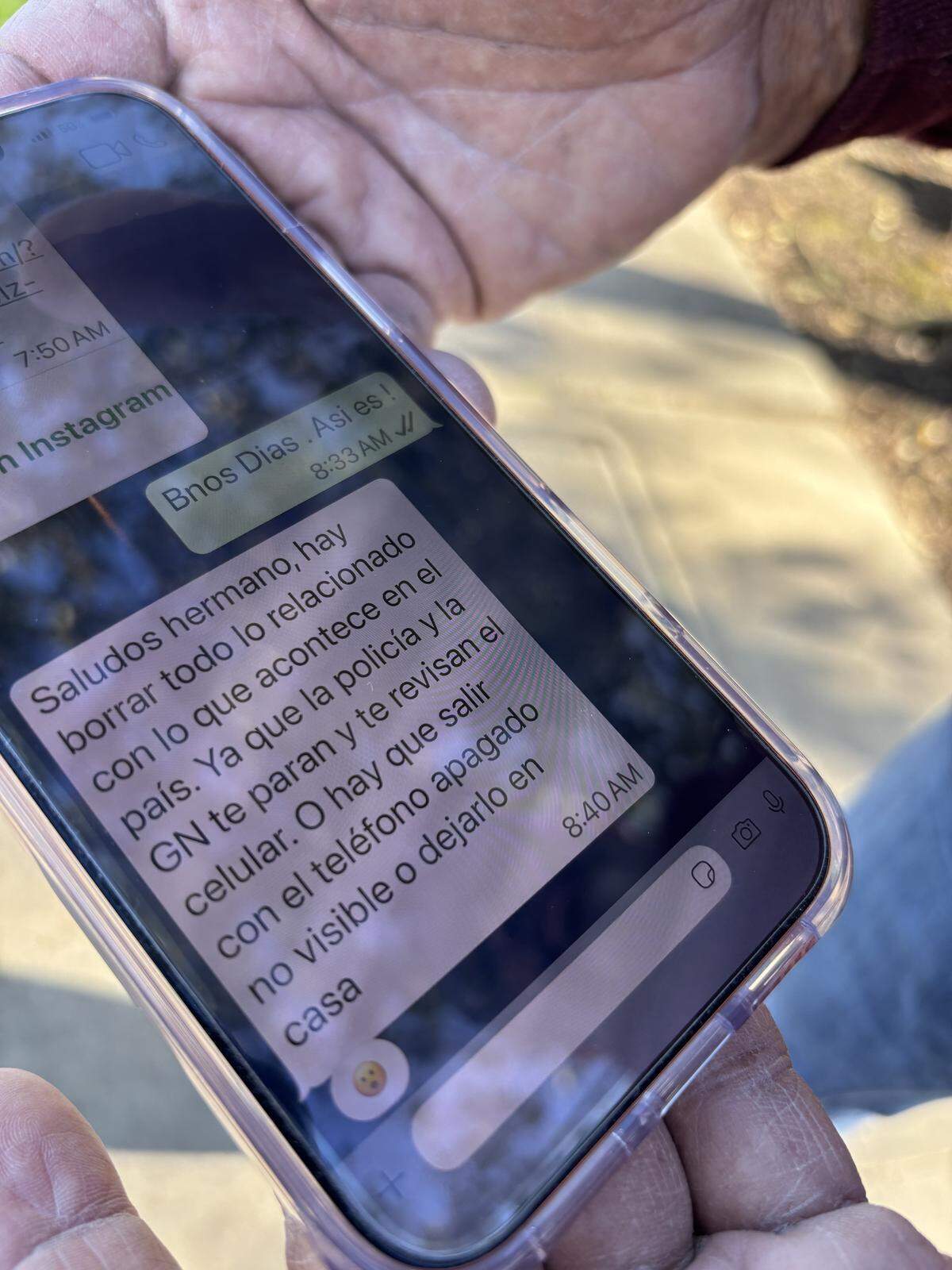
(“Greetings, brother, you have to delete everything related to what’s happening in the country. Because the police and the National Guard will stop you and check your phone. You either have to go out with your phone turned off and hidden, or leave it at home.”)
Alejandro Velasco, historian at New York University’s Gallatin School at the Department of History, said there are three major kinds of emotions among Venezuelans, including those living in the United States, in response to the U.S military intervention: Anxiety and confusion, but also the expectation of possibly a better future.
“As dramatic as the events on Saturday (Jan. 3) were, nothing really has changed in terms of the players who are in power, with, of course, the major and significant exception being Maduro, right?,” said Velasco.
While Maduro was removed from power, Carlos said nothing has changed because the regime put in place by Maduro is still in power.
The Venezuelan community is not that big in the Central Valley, Carlos estimates that about 150 Venezuelans live in Fresno with larger communities in Bakersfield.
Like Carlos, a Visalia resident who wants to be identified as Katiuska for safety reasons is also worried about the safety of her loved ones back home.
“I’m going to cry. It was a mix of feelings, uncertainty, and happiness,” she said, adding questions that came to mind. “What ‘is going to happen? Why they (U.S military) didn’t take the whole group?”
Katiuska, who immigrated to the Valley in 2007 and is now a U.S. citizen said people that were part of Maduro’s regime are still in charge.
“So, for us, it’s the same thing still,” she said. “I have talked to friends who are there. They are sheltered at home; they can’t go outside.
“The situation in my country is really bad still, even though here they (the government) say things are better now,” she said. “People in my country are still in danger. Regime is not gone yet.”
“Even though we are not in Venezuela, we are afraid to talk,” she said.
While there have been some human rights organization in the Central Valley speaking against the U.S. military action , Katiuska said, “What about the human rights of Venezuelans? What about the people who are there, who have suffered for more than 25 years, that have lost their lives, lost their families.”
“We were happy before (Hugo) Chavez came into power,” she said. “We didn’t emigrate because we had everything in our country. So, what about our rights?”
This story was originally published January 20, 2026 at 1:36 PM.