
Garden pests go wild in spring. Here’s how to fight back without using pesticides
Many species of sucking and chewing pest insects feed on the first flushes of tender new green growth in spring. We see the heaviest infestations of pest insect in spring since our very hot summer weather tends to knock down their populations. Controlling for springtime pests early in the growing season can give the home gardener the upper hand in the battle. Many pest insect populations can be controlled if not eliminated without the use of pesticides.
When aphids are washed off plants with a blast of water from the hose they leave their sucking mouthpieces behind and die. Whiteflies can be washed off plants as well; yellow sticky traps are very effective but must be replaced when covered with dead whiteflies. Square half-inch-long silver or bronze hoplia beetles that chew holes in white roses and other light-colored flowers can be handpicked (use tweezers if you’re squeamish) and stepped on or dropped into a bucket of soapy water. Cotton-cushiony scale and mealybugs are soft-bodied pests that can be smothered with applications of neem oil or horticultural oils.
Snails and slugs can be handpicked (surprisingly effective) and dropped into buckets of soapy water or stepped on. Unlike metaldehyde formulations, iron phosphate baits such as Slug-go and Escar-go are non-toxic to birds, pets and children. Follow snail and slug slime trails back to their hiding places in the early morning or at dusk and sprinkle baits over the area.
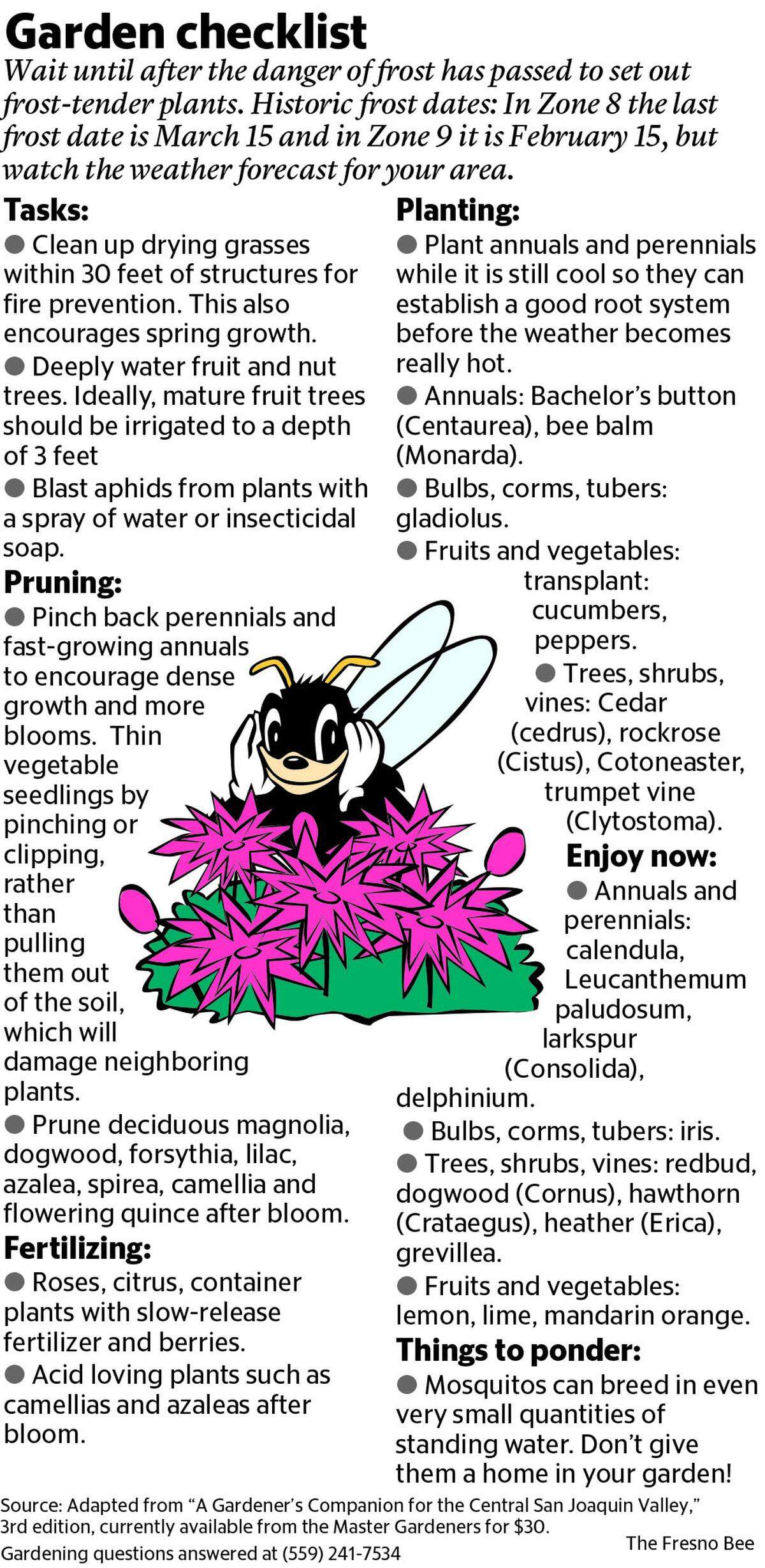
Learn to identify pest insects in your garden. The University of California Integrated Pest Management website offers a full library of downloadable pest notes, often with excellent photos. The Fresno County Master Gardeners are another great source of help in identifying and managing pests, recommending the least toxic control methods first. Their hotline 559-241-7534 is manned weekdays 9 a.m. to noon; leave a message at any time or email your questions to mgfresno@ucdavis.edu.
The Asian citrus psyllid is a recently arrived pest insect that carries the bacterial citrus greening disease also known as Huanglongbing or HLB which poses a serious threat to California’s and the world’s citrus crops. The psyllid nymphs feed only on flushes of soft new leaves, stems and flowers. Mature citrus have two flushes annually, in spring and fall. Young citrus and lemons produce several flushes each year.
The tiny adult psyllids and nymphs can be hard to spot. Look for deformed and twisted new leaves, miniscule yellow eggs inside folded leaves and the white waxy tubes that the nymphs produce to carry away excess excretions of sap. Report any suspected ACP infestations to the California Department of Food and Agriculture exotic pest hotline at 800-491-1899. Call the Fresno County Master Gardeners for help with identification.
Clovis spring festival
The Clovis Botanical Garden at 945 N. Clovis Ave. is hosting its annual Spring Into Your Garden Festival on Saturday, March 16, 9 a.m. to 1 p.m.
Listen to expert garden presentations and take a walking tour of the botanical garden. Admission is $5 for adults, free for kids and CBG members. A breakfast by the Kiwanis Club of Old Town Clovis is $6 for adults, free for ages 5 and under.
For more information, call the CBG at 559-298-3091.