Decades of urban sprawl in Fresno paused by court decision, downtown housing push | Opinion
For decades, Fresno leaders made policy decisions that spurred relentless growth on the city’s fringes and left concentrated poverty and urban decay in existing core neighborhoods.
That pattern has been halted, at least temporarily. California’s fifth-largest city is entering a strange new period in its development history. Call it the “No Sprawl Era.”
This new era is also a result of policy decisions by city leaders – decisions that backfired on them in August when California’s 5th Appellate Court ruled that Fresno’s environmental review process for new construction in several growth areas isn’t up to snuff.
Specifically, the city’s Program Environmental Impact Report used by developers to comply with CEQA does not realistically account for greenhouse gas emissions, improperly defers air quality mitigation measures, finds traffic mitigation infeasible without justification, ignores potential impacts on pedestrians, inadequately addresses groundwater decline and fails to reasonably discuss alternatives.
The city must address each of those six points to the court’s satisfaction. Until then, dozens of construction projects – including hundreds of new homes – are reportedly on pause.
“It’s essentially a moratorium,” land consultant Dirk Poeschel told GV Wire, the news website owned by one of the area’s largest home builders.
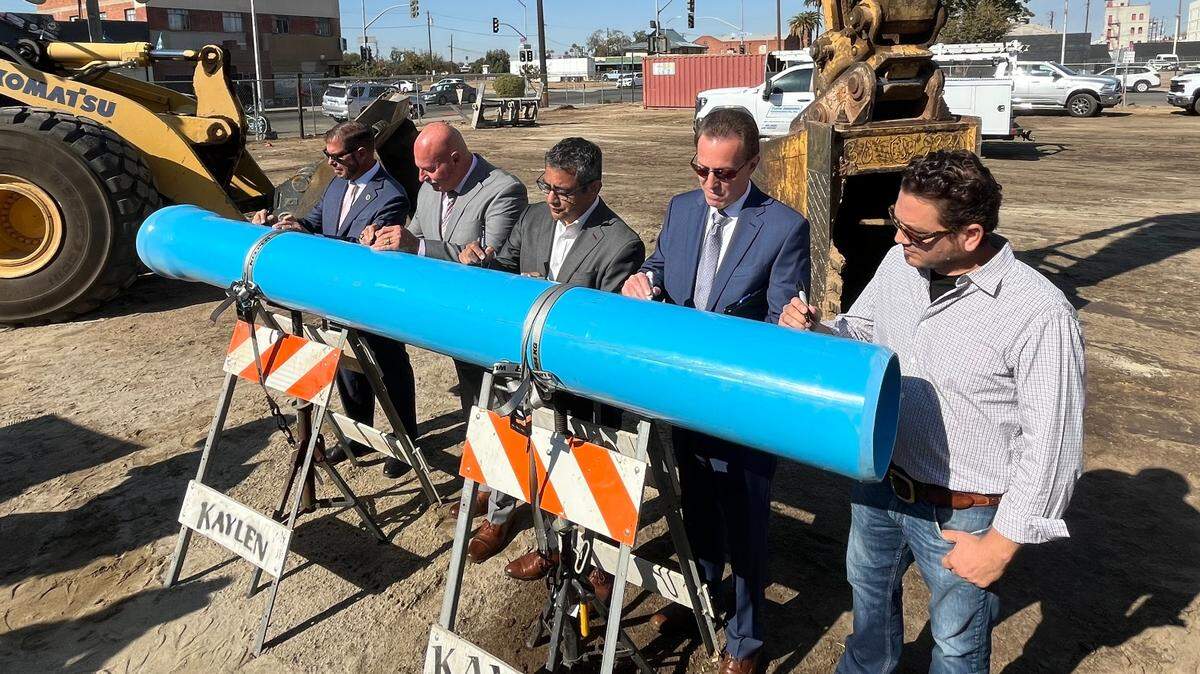
The appellate court ruling covers most of Fresno, including the long-planned (some would say irresponsibly so) Southeast Development Area. However it does not apply to downtown or the adjacent Chinatown district, where Mayor Jerry Dyer and other city officials gathered Wednesday for a ceremonial water pipe burial.
Below his signature on the segment of blue pipe, Dyer thanked Gov. Gavin Newsom for the state’s investment in a $22 million project to replace roughly 4.5 combined miles of century-old water and sewer mains in the area bounded by Fresno, M and E streets and Cesar Chavez Boulevard.
‘Tipping point’ for revitalized downtown
Dyer’s aim is to have 10,000 people living downtown, a figure he believes will be the “tipping point” for creating a vibrant community of full-time residents with retail, night life, green space and walkability. While not sexy or headline-grabbing, the new infrastructure is a crucial piece of that puzzle because it relieves developers from the financial burden of making such improvements.
“This project truly kicks off the city’s commitment to making the downtown core a place that people really want to live and work,” Director of Public Utilities Brock Buche said.
How soon can that happen? Dyer mentioned five different projects in various stages of progress that could house 2,000 people within 24 to 36 months. The most exciting (and potentially game-changing) of these involves the revitalization of two largely vacant Fulton Street edifices, the elegant 10-story Helm Building and hulking six-story JC Penney building.
During their respective heydays, the Helm Building was occupied by business offices and law firms while the JC Penney (originally the Radin & Kamp Building) was a department store. Both will eventually be mixed-use developments, which remains a nascent concept in Fresno.
Because why worry about infill housing when there’s always the opportunity to extend the city’s boundaries by building new housing tracts and their requisite strip malls on the fringes?
Always, except during this court-mandated moment in time – aka “The No Sprawl Era.”
Study quantifies Fresno sprawl
In a recent study entitled “Patterns of Sprawl in Fresno and the Central San Joaquin Valley,” researchers with the Urban Institute found the region’s urbanized land area has grown by 226% since 1970, more than the concurrent population growth of 153%. At the same time, less than 30% of all new housing during each decade was built in infill areas – primarily land that hadn’t previously been developed and until then used for agricultural or natural purposes.
“If Fresno had chosen to invest in existing neighborhoods instead of creating new, sprawling subdivisions, it may have been able to avoid the racialized patterns of disinvestment and decay that we observe today,” the authors wrote.
Until the court’s specific concerns about Fresno’s PEIR are addressed, developers eager to build on the city’s outskirts are required to follow a much more cumbersome process to satisfy California’s environmental laws. Something they aren’t used to doing.
At the same time, city leaders are incentivizing downtown housing projects with much-needed infrastructure investments. Something that rarely occurs.
The “No Sprawl Era” is a strange new world for Fresno, for however long it lasts.