
Should Fresno spend $70 million on parking decks? Here’s what leaders, experts say
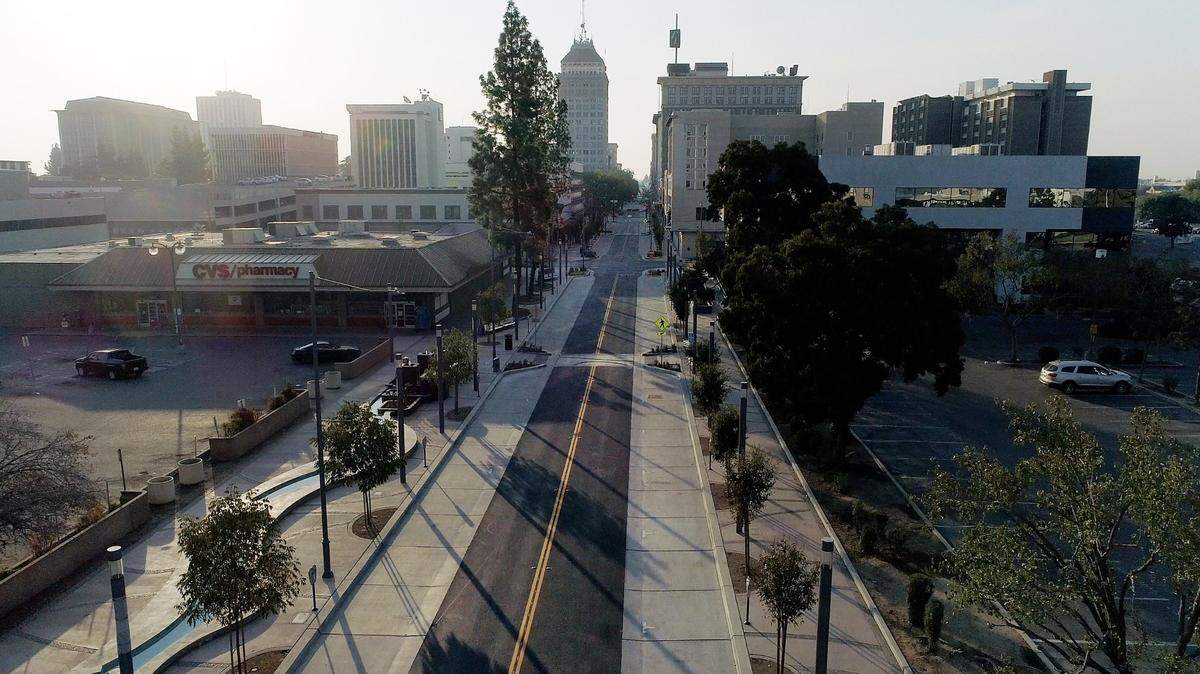
The city of Fresno’s plans to build new parking decks downtown with money from the state’s $250 million infrastructure investment has raised questions about whether more spaces are really needed, and whether the city should be focusing instead on alternative transportation options to attract more residents to visit downtown.
Parking currently covers 30% of the city’s downtown land, which is already a large share compared to other city downtowns, according to the Parking Reform Network, a nonprofit that works to educate the public on the impact of parking policy on climate change, equity housing and traffic.
In contrast, only 5% of Manhattan is dedicated to parking, said Tracy Hadden Loh, a fellow at the Anne T. and Robbert M. Bass Center for Transformative Placemaking at Brookings Metro.
Even so, an estimated $70 million of the $250 million for infrastructure downtown is slated for two new parking structures that would add 2,000 parking stalls. Loh says she hasn’t heard much about the plans the city of Fresno has earmarked for transportation alternatives for residents to get to downtown without having to drive a car. She said she believes it’s important that Fresnans ask questions about why so much money is going into parking.
“That’s actually a question mark that I have about the investment,” said Loh, whose independent research group focuses on finding solutions to challenges in society. Economic development and transportation are among Loh’s research areas, but she has done much work on downtown revitalization.
Mayor Jerry Dyer says additional parking is needed for the city’s future downtown residents. The parking, he says, is going to be connected to the city’s transportation goals and will link residents and visitors to the larger public transit system.
Dyer said the city currently owns, operates and maintains 2,081 parking spaces downtown.
“At this time, the proposal to build two new parking structures is one of our suggestions,” he said in a statement in response to questions from The Bee, “as the need for additional parking spaces may realize itself in multiple, smaller locations throughout Downtown.”
Lejon S. Brooks, community organizing and outreach coordinator for the Council on American-Islamic Relations, Sacramento Valley/Central, in a Valley Voices piece published in The Bee, said it’s imperative that officials listen to low-income communities as decisions are made on how the city spends the state money.
He made one thing clear: Families must benefit from downtown revitalization. “It can’t be parking structures to serve high-speed rail,” he said.
There’s no timeline for when a high-speed rail station in Fresno might be built, but work is underway on the design. The trains are expected to start running sometime between 2030 and 2033, according to the latest estimates that have been provided by the California High-Speed Rail Authority and previously reported.
Dyer said many details on the parking still need to be finalized, but they are designed to “support residents who will soon call Downtown home.”
“Furthermore, the parking is absolutely connected to our overall transportation goals - the BRT (Bus Rapid Transit) system,” he said, “and our new proposed intermodal center that would provide both residents and visitors access to the City’s public transit system.”
The intermodal center would ensure the success of Fresno’s downtown high-speed rail station.
The city’s goal, Dyer said, is to increase the 3,000 residents living in the downtown core area to more than 10,000. The downtown district area already includes zoning for almost 75,000 residential housing units. Developers hadn’t been interested in building housing downtown because the lack of infrastructure made it more expensive for them.
That could change now that the infrastructure is going to be paid for by the state.
“This will include residential and mixed-use buildings that will provide high density, walkable, and equitable housing opportunities,” he said in this week’s statement. “In making this historic investment, the hope is to attract new investors, businesses, and entrepreneurs. We want to create and retain jobs and revitalize the area.”
Parking will have to be part of the revitalization plan, if housing downtown is expected to be built in the density that’s appropriate for the area, said Elliot Balch, president and chief executive officer for the Downtown Fresno Partnership.
The question is whether the parking should “take a bunch of land,” he said, or be compacted so more land is available for housing. “We are not going to get there by leaving it to individual projects to just come up with their own parking solutions,” he said.
Balch noted that with more parking supply, comes parking management, and how prices are set is important. For example, he said, an issue that has been seen over the last couple of months downtown is that people not attending events downtown still have to pay the same event parking rate.
Parking prices, in general, can have ripple effects.
“It really does affect how well business owners do,” he said, “so we want to be working with the city hand-in-hand.”
Gustavo Piñeda Nava, owner of Gus Kabobs at the heart of downtown on Kern Street near M Street, said he doesn’t believe there’s a need for more parking downtown.
But a problem that has affected him as a downtown business owner, and more directly his clients, is the metered parking. Nava says he often sees clients who are in the middle of their meal when they have to run outside to put more money in their parking stall to avoid getting a ticket.
Nava, who opened Gus Kabob in 2016, says it makes him feel bad that his customers sometimes can’t enjoy their meal without being interrupted by concerns about getting a parking ticket. He said it would be great if the city stopped charging for parking after 3 p.m. or 4 p.m.
“That’s a problem that I’ve always wanted to talk to someone about,” Nava said in Spanish. “It affects businesses, and the city seems to be very hungry to charge.”
But in terms of enough available parking, he said, that hasn’t been a problem for his clients. He says there are many empty parking space in the area, especially because many people are still working from home post-pandemic.
Nova believes the city could use the $70 million for other infrastructure improvements, such as brightening the downtown city street lights, for example, but also to address other issues, such as homelessness.
This story was originally published September 19, 2023 at 10:37 AM.
.jpg)